
A large Danish study has put statins and dementia back into health headlines. Researchers followed more than 132,000 people with type 2 diabetes and reported a lower ten-year dementia risk among those who started a statin soon after diagnosis.
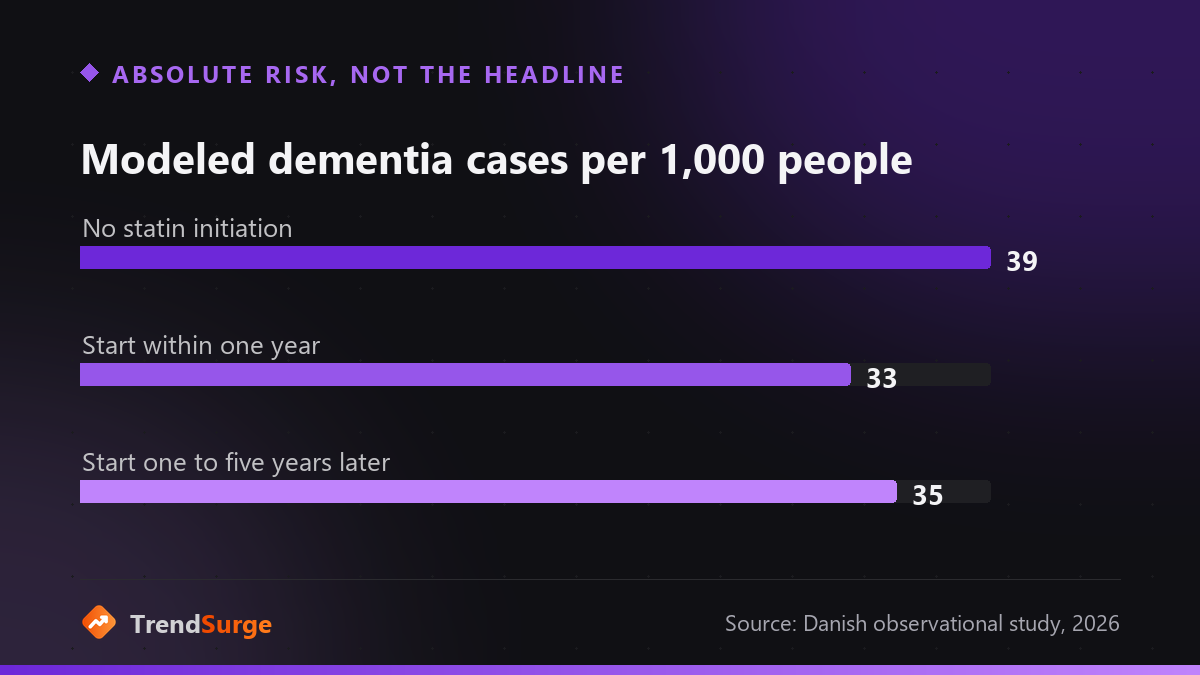
The “15% lower risk” was relative, not a 15-percentage-point drop. Estimated ten-year dementia risk was 3.9% without statin initiation, 3.3% with a start within one year of type 2 diabetes diagnosis, and 3.5% with a start one to five years later. That is an absolute difference of 0.6 percentage points for early initiation, and the observational design cannot prove that the medicine caused it.
The result is potentially important, but it is narrower than “statins prevent dementia.” It applies to a defined Danish population, compares treatment timing after a diabetes diagnosis, and needs randomized-trial evidence before anyone treats dementia prevention as a new indication.
What the researchers actually studied
The paper, published online Aug. 27 in The Lancet Regional Health – Europe, used Denmark’s nationwide health registers. It identified 132,585 people who developed type 2 diabetes between 2006 and 2019 and had not previously used statins. Follow-up continued until dementia, death, emigration or the end of 2021, with a median of 7.1 years.
Researchers compared three strategies: no statin initiation during the first five years after diabetes diagnosis, “early” initiation within the first year, and “late” initiation between one and five years. They used a target-trial-emulation method intended to make an observational comparison behave more like a planned trial, including weighting and treatment of death as a competing risk.
Among the full group, 3,592 people, or 2.7%, developed dementia during observed follow-up. The modeled ten-year risks were 3.9%, 3.3% and 3.5% across the three strategies. Early initiation was associated with a 15% lower relative risk than no initiation; late initiation was associated with a 10% lower relative risk.
“Early” therefore does not mean that every healthy young adult should start medication. It means within one year after a type 2 diabetes diagnosis in people who were statin-naive. That missing phrase radically changes the claim.
Relative risk makes the headline; absolute risk gives it scale
Relative risk compares one rate with another. Moving from 3.9% to 3.3% is roughly a 15% reduction relative to the starting risk. Absolute risk simply subtracts: 3.9 minus 3.3 equals 0.6 percentage points.
Both descriptions are mathematically valid. They answer different questions. Relative change helps researchers compare effects across groups; absolute change helps an individual understand magnitude. A headline using only the larger-looking number can leave readers imagining that 15 of every 100 people avoided dementia, which is not what the study estimated.
The confidence interval for the early relative reduction ran from 9% to 21%, while the estimated absolute difference ran from 0.34 to 0.86 percentage points. Those ranges communicate statistical uncertainty. They do not include every possible source of bias in registry data.
This kind of number check is also useful beyond medicine. Our explanation of the Social Security 78% funding projection similarly separates a percentage from the scenario and denominator that give it meaning.
Why an association can appear without a drug effect
People who start statins promptly may differ from people who do not in ways that registers cannot fully measure. They may visit clinicians more often, follow other preventive advice, have different cholesterol levels, or receive more coordinated diabetes care. Researchers can adjust for recorded factors, but not for every behavior or clinical judgment.
Treatment can also change over time. Filling a first prescription does not prove that a person took the medicine consistently for a decade. Conversely, the comparison group may start after the five-year strategy window or receive other risk-reducing care.
The authors explicitly call for trial evidence to confirm the findings. Independent experts quoted in the Guardian made the same point: observational research can reveal an association but cannot establish that statins themselves caused the lower dementia rate.
There is also evidence that does not point in the same direction. A 2025 target-trial-emulation study in Neurology examined more than 322,000 matched participants in a large U.S. health system. After the first year, it found essentially no difference in Alzheimer’s disease and related dementia incidence between statin initiators and non-initiators. The populations, designs and questions differ, so one result does not simply cancel the other. Together they show why a fresh association should not be promoted as settled prevention advice.
Why the biological idea is still plausible
Statins lower LDL cholesterol and are established tools for reducing cardiovascular risk in appropriate patients. Type 2 diabetes raises the risk of vascular disease. Blood-vessel damage and stroke can also contribute to cognitive decline and vascular dementia, so improving cardiovascular health could plausibly protect the brain over time.
That mechanism is not the same as treating Alzheimer’s disease directly. The Danish study examined whether dementia diagnoses occurred, not whether statins reverse symptoms in people who already have dementia. Reviews of trials using statins as dementia treatment have not shown a meaningful improvement in standard cognitive measures.
The distinction between prevention, association and treatment is essential. A medicine can be useful for its approved cardiovascular purpose even if its effect on dementia remains uncertain. It can also be a poor or unsafe choice for a particular person despite a promising population-level association.
What the study does not tell an individual to do
It does not establish a universal age to start a statin. It does not compare every statin or dose. It does not show that someone without diabetes receives the same dementia association. It does not say that a person already living with dementia should begin or increase treatment. And it does not justify stopping a prescribed medicine because another study reported a null result.
Statin decisions usually consider LDL cholesterol, diabetes, previous cardiovascular disease, age, other risk factors, possible interactions and side effects. The NHS notes that some people experience muscle symptoms or other adverse effects and that clinicians may adjust the dose or product. That discussion belongs with a qualified prescriber who has the patient’s history, not with a trend article.
The same source-discipline applies to seasonal vaccine decisions. Our 2026 flu-shot guide identifies which claims come from current clinical guidance and which come from emerging evidence. A new paper can change a conversation without instantly changing a recommendation.
Better questions to ask about the finding
For researchers, the next question is whether the association survives in other countries and health systems, especially with comparable definitions of treatment timing and dementia. Subgroup work should test whether age, sex, baseline LDL, diabetes severity, prior cardiovascular disease or specific statin exposure changes the result.
For trial designers, the challenge is time. Dementia develops over years, so a randomized prevention trial is expensive and must keep participants engaged while treatment and health conditions evolve. A useful trial would also measure cardiovascular outcomes, because that is the established reason many participants would take a statin.
For patients, a more practical question is whether their current cardiovascular prevention plan matches established guidance. If a statin has already been prescribed, adherence, side effects and interactions are appropriate topics for the prescribing clinician or pharmacist. Dementia headlines should not replace that conversation.
What happens next
The study was presented Aug. 30 at the European Society of Cardiology’s 2026 congress, so specialists will now examine its assumptions, methods and applicability. Publication makes the full analysis available for that scrutiny; conference attention does not make the conclusion final.
The most honest takeaway is modest but useful. In a large group of Danish adults with newly diagnosed type 2 diabetes, starting a statin within a year was associated with a slightly lower modeled ten-year dementia risk than not starting within five years. The absolute gap was about six people per 1,000, and causation remains unproven.
That is not a miracle-drug headline. It is a credible signal about the possible connection between vascular health and brain health, framed at the size the data actually support.