Key Takeaways
- The southern decagon is a ten-sided wave within a jet stream, not a solid geometric structure.
- Hubble data trace the feature back to 2023; ground-based observers noticed hints in 2024 and 2025.
- Observations at different wavelengths indicate that it extends through multiple atmospheric layers.
- Its cause, longevity, and relationship to the northern hexagon remain open research questions.
Saturn has a ten-sided atmospheric wave around its south pole, and Hubble observations suggest the pattern is strengthening. It is a different feature from the famous six-sided hexagon at the north pole: a newly recognized southern structure that scientists can now study as it evolves.
NASA’s September 2 announcement, updated September 4, traces the southern feature in Hubble data back to 2023. That does not mean Saturn grew a decagon overnight this week. The news is that several years of observations now reveal a coherent, developing pattern—and leave scientists with a new question about why it formed.
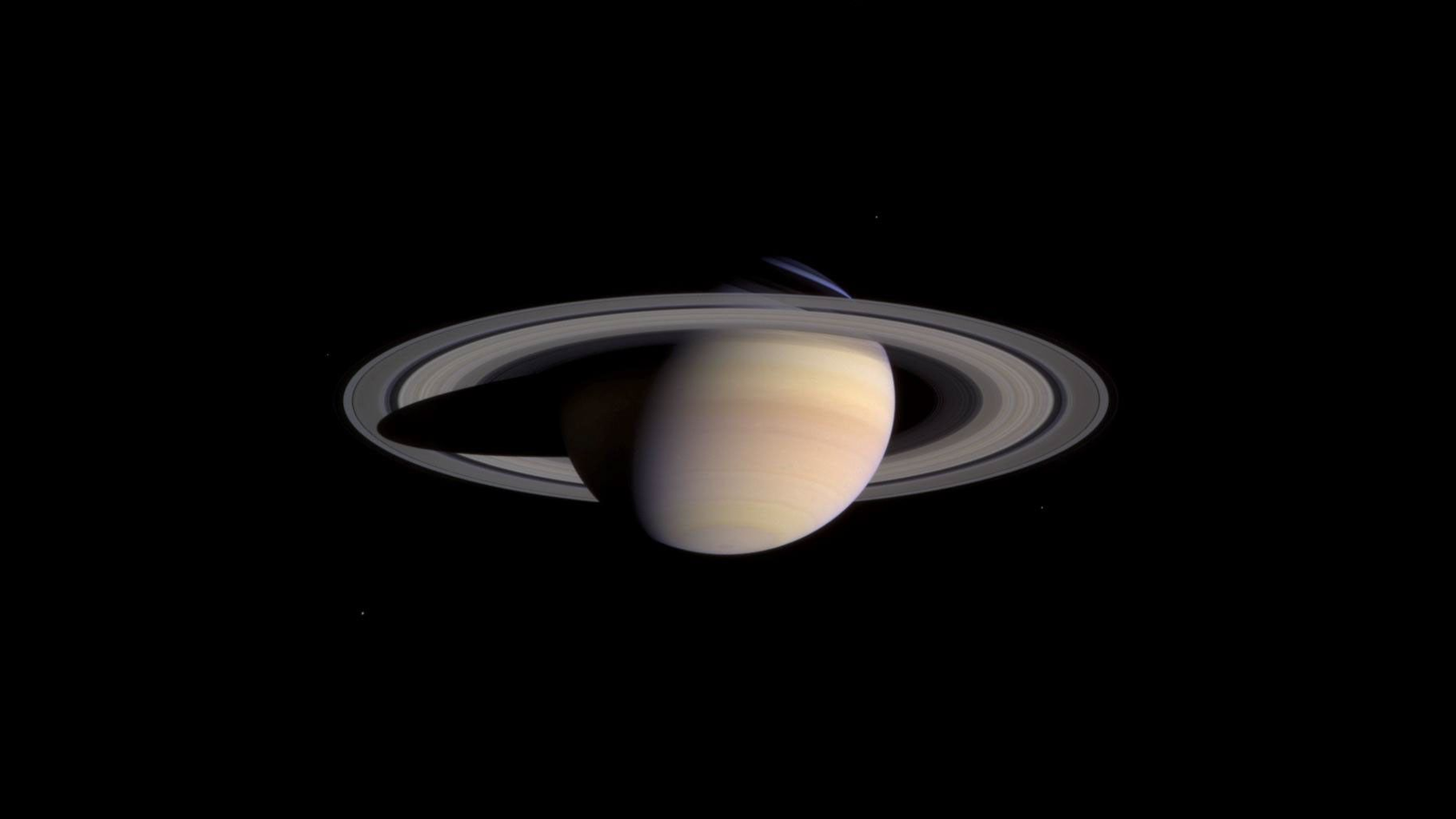
Hero photograph: NASA/JPL/Space Science Institute, Cassini's March 27, 2004 view of Saturn; archival context, not the decagon discovery image. Image source · NASA editorial reuse guidelines. Resized with black padding.
What “ten-sided” means on a gas giant
The discovery concerns a large atmospheric wave following a path around Saturn’s southern pole. Its repeated bends form a ten-sided outline. NASA describes it as the first large, regular-sided jet pattern observed in the planet’s southern hemisphere.
That geometry can look startling because straight edges and corners suggest something rigid in everyday life. Here, the outline belongs to moving atmosphere. The feature sits within one of Saturn’s powerful jet streams and changes as the surrounding atmospheric system evolves.
Calling it a decagon names the observed pattern; it does not explain the mechanism that created it. Scientists still need observations and computer modeling to work out why this particular wave formed, why it has ten sides, and whether it will persist.
The distinction is useful when reading discovery headlines. “Scientists observed a ten-sided pattern” is an observational result. “Scientists know why Saturn makes this pattern” would be a stronger claim. NASA’s account clearly presents the second question as unfinished.
The discovery began with observers on Earth
The story was not one lucky Hubble photograph. As Saturn’s changing seasons brought its southern pole back into view from Earth, ground-based observers began spotting hints of an undulating band.
Agustín Sánchez-Lavega of the University of the Basque Country and amateur astronomers Trevor Barry and Jean-Paul Oger noticed those hints in 2024. Additional ground-based imagery in 2025 made the possible decagon more convincing, according to NASA.
The university’s Planetary Virtual Observatory Laboratory accepts images from observers around the world. That shared record helped identify a target worth investigating more closely. Hubble then contributed sharp observations from above Earth’s atmosphere and a record that researchers could inspect across several years.
Working backward through Hubble imagery established the feature’s presence as far back as 2023. The finding therefore combines recent recognition with older evidence. The announcement date, first ground-based hints, and earliest Hubble detection are three different dates answering three different questions.
Hubble adds depth as well as a sharper outline
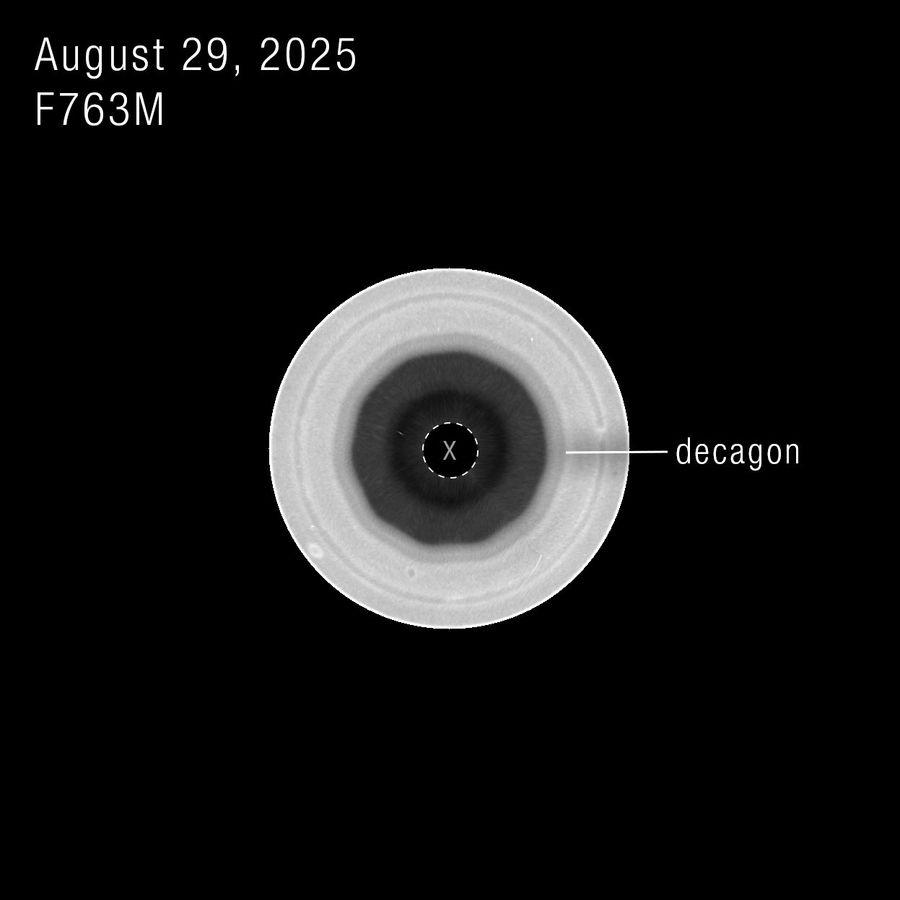
The wave’s apparent position shifts slightly when Hubble observes Saturn at different wavelengths. Those wavelengths probe different altitudes in the atmosphere. NASA says the observations show the feature extending through multiple layers, rather than being confined to a single visible cloud level.
That gives researchers a more substantial problem to explain than a temporary shape in one photograph. A model of the decagon has to account for a structure that extends vertically through the atmosphere, as well as its ten-sided path around the pole.
The published single-filter image also contains an important visual detail: an X marks a region where data were not captured. It is not a mark on Saturn and does not identify the physical center of an object discovered on the planet. The image’s annotations explain the observation and its limits.
How it differs from the northern hexagon
Saturn’s northern hexagon has appeared whenever scientists have been able to examine it for more than four decades, NASA says. The southern decagon appears to be developing and strengthening. That contrast in their observed histories is at least as interesting as the difference between six sides and ten.
NASA’s Cassini hexagon overview explains that Voyager first observed the northern feature during the 1980 and 1981 encounters. Cassini later supplied much closer views during its Saturn mission from 2004 to 2017.
Even that familiar feature was affected by observing conditions. Saturn’s northern hemisphere was in winter when Cassini arrived, so scientists initially studied the hexagon in infrared wavelengths before sunlight returned to the region. Saturn takes about 29 Earth years to orbit the Sun, making its seasons much longer than ours.
The southern discovery is not evidence that the northern hexagon moved, changed sides, or grew four extra corners. The two features occupy opposite hemispheres. Researchers want to compare them precisely because they share a broad kind of atmospheric organization while differing in shape and apparent persistence.
Why the archive matters more than one dramatic image
The Hubble images came from the Outer Planet Atmospheres Legacy program, usually called OPAL. It repeatedly observes the outer planets to build a long-term record of their atmospheres. NASA’s ten-year OPAL retrospective describes routine annual observations of Jupiter, Saturn, Uranus, and Neptune near their closest approaches to Earth.
A repeated observation program can answer questions a single image cannot. It can show whether a feature existed before someone recognized it, whether an apparent change persists, and how a pattern relates to seasonal conditions. The decagon is a concrete example: the archive allowed researchers to trace its earlier development.
The scientific importance of the telescope therefore includes continuity. Hubble’s long operating life does not only produce more pictures; it gives those pictures a time dimension. Researchers can compare a newly noticed structure with earlier views made through the same long-running program.
It is also a reminder that a discovery need not begin with a brand-new spacecraft. Ground-based contributors, an established telescope, and a carefully maintained archive can together reveal a change that none of them could explain as well alone.
What happens next
The research team plans to keep observing Saturn to learn whether the decagon becomes a stable, long-lived pattern or continues evolving. NASA says further Hubble and James Webb observations, together with computer models, are needed to investigate its formation and longevity.
Two future results will be particularly useful for readers to watch: evidence that the shape persists across additional observations, and an explanation that accounts for its vertical structure. A striking image establishes something to investigate; repeated measurements and a tested model would explain more of how it works.
The discovery is separate from everyday skywatching. Our September observing guide covers accessible celestial events; the detailed polar analysis described here uses research observations. Our Roman telescope explainer looks at another mission whose scientific value depends on measurements after launch, rather than the launch image alone.
Quick poll
What would you most like scientists to explain about the decagon?
NASA identifies formation, longevity, and comparison with the northern hexagon as open questions.
FAQ
Did Saturn’s hexagon turn into a decagon?
No. The hexagon is at the north pole, while the newly recognized decagon is at the south pole. They are separate atmospheric features.
When did the southern decagon appear?
Hubble data confirm its presence back to 2023. That is the earliest presence established in this account, not a precise date when the wave first formed.
Is it a solid shape on Saturn?
No. It is a ten-sided atmospheric wave within a jet stream, extending through multiple atmospheric layers.
Do scientists know why it formed?
Not yet. NASA says additional observations and modeling are needed to understand its formation, possible lifespan, and relationship to the northern hexagon.