Key Takeaways
- The 2026 trustees report projects the OASI trust fund exhausts its reserves in the fourth quarter of 2032 — one quarter earlier than last year's estimate, per CBS News.
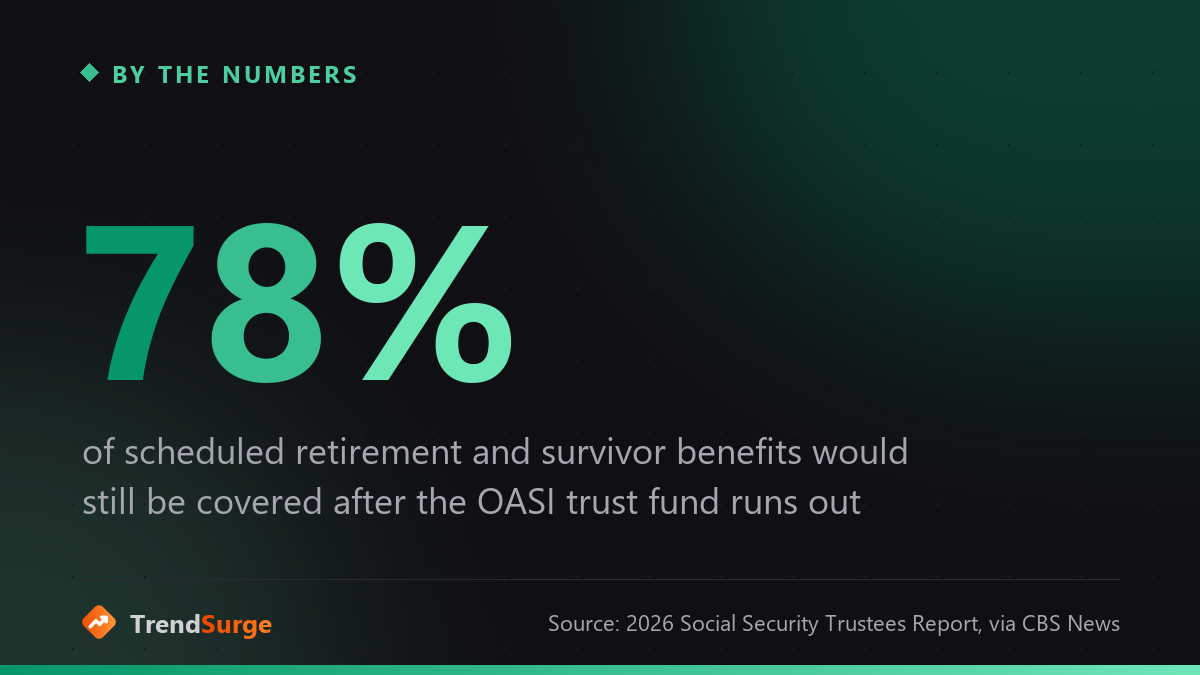
- At that point program income would cover 78% of scheduled retirement and survivor benefits; the Committee for a Responsible Federal Budget estimates an across-the-board cut of roughly 22%.
- The 2027 cost-of-living adjustment is estimated at 3.4% to 3.6%, up from 2.8% in 2026, with the official figure due from SSA in October, according to CNBC.
- Delaying a claim past full retirement age still adds 8% a year up to 70 — and a bigger dollar share of every future COLA.

Social Security is not going to stop paying benefits in 2032. What the 2026 Social Security Trustees Report projects is narrower: the trust fund behind retirement and survivor checks — the Old-Age and Survivors Insurance fund, or OASI — is on track to exhaust its reserves in the fourth quarter of 2032, one quarter earlier than last year’s projection, according to CBS News. Payroll taxes keep flowing after that; they just would not cover the full promised amount. Without legislative changes, program income would fund 78% of scheduled retirement and survivor benefits.
That number is driving this week’s coverage — Politico’s headline called it a “benefit cliff” Washington “is struggling to wake up” to. Here is what it means in practice, what next year’s raise looks like, and what planners say to do with the six-plus years in between. (Curious why a topic spikes in search? We broke down how to read a Google Trends spike.)
What the 2032 date actually means
Start with what does not happen. “That doesn’t mean Social Security will disappear in 2032,” CBS News writes — payroll taxes would keep flowing in even if OASI reserves were depleted. The trust fund is a buffer, not the funding source.
What does happen, absent action from Congress, is a gap. The Committee for a Responsible Federal Budget, a nonpartisan fiscal policy group, estimates the 78% figure works out to an approximately 22% across-the-board reduction, according to Fortune, though CBS News stresses a cut that size “isn’t a guaranteed outcome.” The 2032 date is also specific to the retirement and survivors fund: Fortune notes the theoretically combined trust funds are projected to be depleted in 2034, when revenue would cover 83% of scheduled benefits.
The funding math behind the shortfall
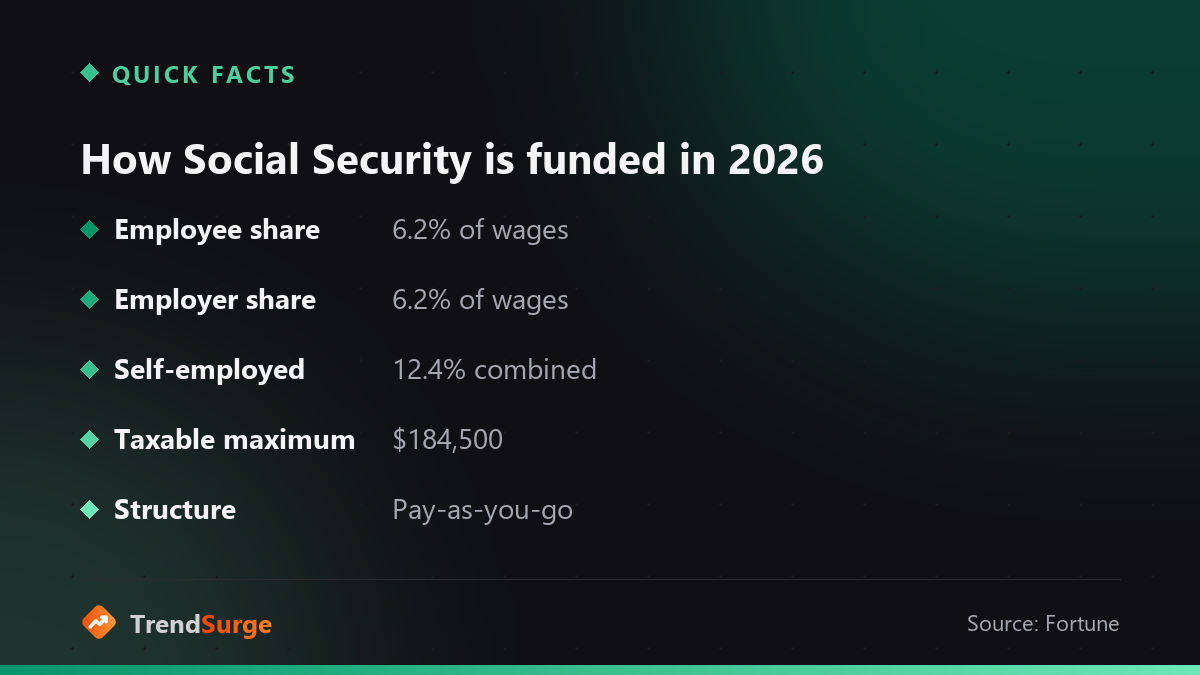
Social Security is a pay-as-you-go program: most payroll taxes collected from today’s workers pay today’s beneficiaries, as Fortune explains. Employees and employers each pay 6.2% of wages up to an annual taxable maximum of $184,500 in 2026, and self-employed workers pay the combined 12.4% rate.
That worked more smoothly when there were many workers per retiree, Fortune writes, and the demographic math has changed. Its illustration of the imbalance: a median-wage worker retiring in 2027 is expected to receive roughly $730,000 in lifetime benefits, versus less than $200,000 in combined contributions from worker and employer — all against a national debt that passed $40 trillion this month.
The COLA everyone is watching right now
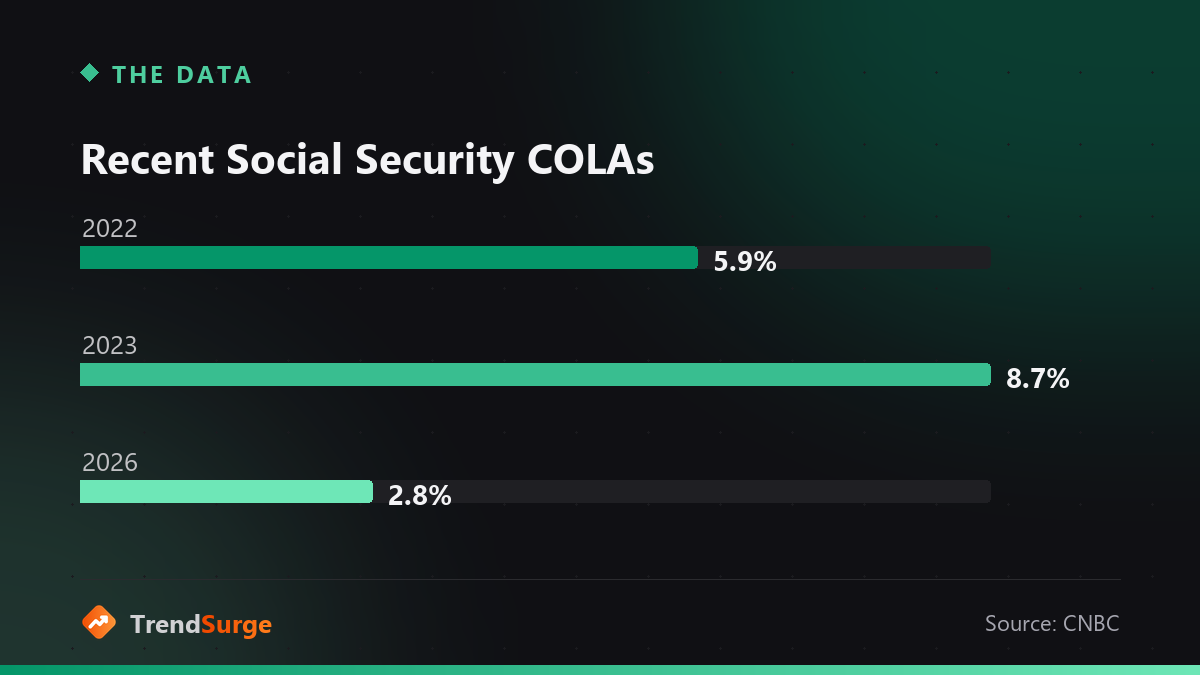
The other reason Social Security is trending: next year’s raise looks bigger. Recent estimates put the 2027 cost-of-living adjustment between 3.4% and 3.6% — the largest in several years, as inflation stays elevated due to factors like the Iran war — CNBC reports. About 75 million Americans saw a 2.8% boost to Social Security and Supplemental Security Income benefits in 2026.
Nothing is official yet: the COLA is calculated from third-quarter inflation data, and SSA usually announces it in October. Independent Social Security and Medicare policy analyst Mary Johnson told CNBC the U.S.–Canada trade war may only moderately affect 2027 estimates, since it landed later in the quarter. For perspective, CNBC notes COLAs hit 5.9% in 2022 and 8.7% in 2023 — the largest in decades — while in 2010 and 2011 the adjustment was 0%.
Why claiming early to “lock in” a big COLA backfires
A large COLA tempts people to file now so they don’t miss it. The math runs the other way, per CNBC: for every year you wait past full retirement age, up to 70, your benefit rises about 8% — and the annual COLAs then apply to that larger base.
James Mahaney, a certified financial planner at Mavericus Retirement Services, laid out the arithmetic in a July paper, “The Hidden Optionality of Social Security: Why Waiting to See Each Year’s COLA Can Pay Off.” In his example, an SSA statement shows $2,250 a month at 62, $3,000 at full retirement age and $3,960 at 70. With COLAs layered in, those become $2,250, $3,205 at 66 and $5,091 at 70 — roughly a 76% total benefit boost, plus roughly 76% more of every annual COLA.
The 2023 adjustment shows the compounding: for two hypothetical beneficiaries with the same $3,000 full-retirement-age benefit, the 8.7% COLA would have added $225 a month for the one who claimed at 62 and $395 for the one who claimed at 70, per Mahaney’s research cited by CNBC. That $170 monthly gap is $2,040 over a year — and it does not lapse.

What Washington is actually debating
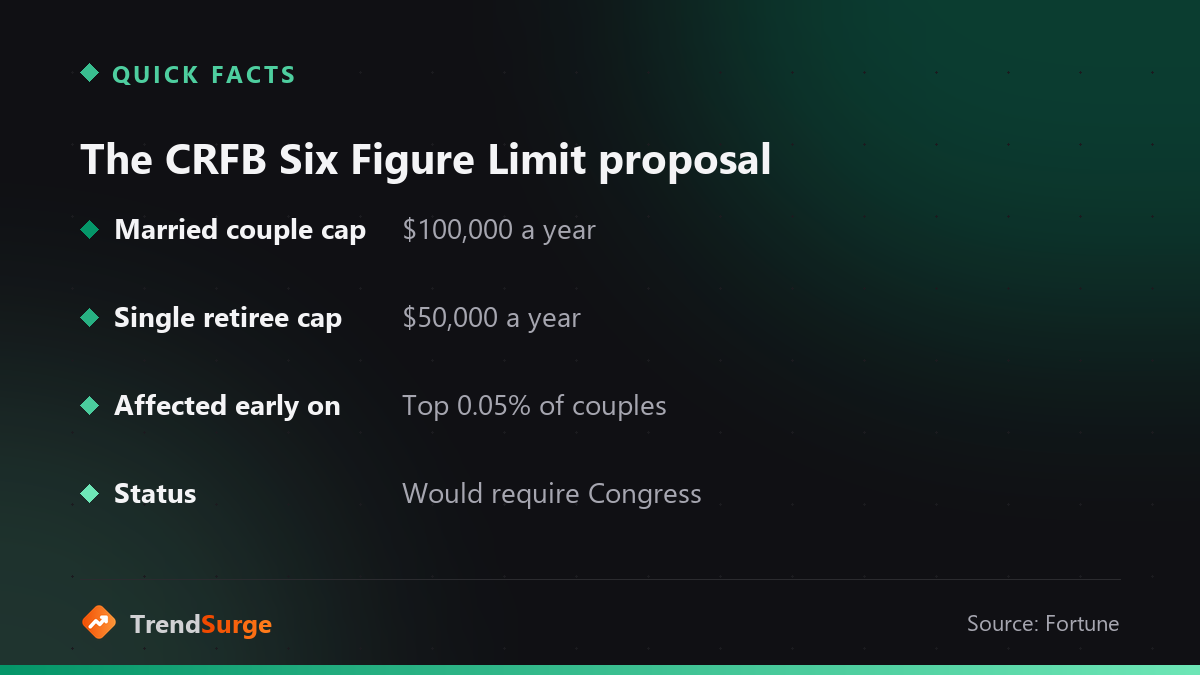
Any change to benefits has to be enacted by lawmakers, CNBC notes, and one proposal drawing attention is a cap on the largest checks. The CRFB has floated a “Six Figure Limit” capping benefits at $100,000 annually for a married couple retiring at the normal retirement age, with a comparable $50,000 limit for a single retiree, adjusted for marital status and claiming age, according to Fortune.
The group estimates the cap would affect only the top 0.05% of couples in its early years — households with average annual retirement income above $2.5 million and average net worth above $65 million — and would grow more consequential as maximum benefits rise. The CRFB has separately proposed capping annual COLA increases for the largest benefits, CNBC reports; SSA did not immediately respond to Fortune’s request for comment.
Public expectations have already moved. A December 2025 Cato Institute survey found only 34% of Gen Z respondents expected Social Security to exist when they reach retirement, per Fortune.
What planners tell people to do with the next six years
There is no single answer, CBS News writes — how much you rely on Social Security, plus home equity, savings, debts and ability to keep working, all change the calculus. It lays out four levers, each with a tradeoff.
Annuities turn part of your savings into payments for a set period or for life. But CBS notes fees, surrender charges, payout structures and liquidity vary widely between products, and overbuying leaves less accessible cash for emergencies.
A reverse mortgage — usually a home equity conversion mortgage, for qualifying homeowners 62 and older — converts equity into monthly payments, a credit line or a lump sum, with no monthly principal and interest payments while loan requirements are met. The catch: interest and fees accrue against remaining equity, and property taxes and homeowners insurance still come due.
Debt relief matters most if unsecured balances already eat a large share of monthly income. CBS reports debt settlement can cut qualifying balances 30% to 50% on average for a lump-sum payment, but carries credit damage, fees and possible taxes on forgiven balances.
Working longer is the fourth, and it overlaps with the claiming math above.

What happens next
Two clocks matter. The short one runs out in October, when SSA is expected to announce the official 2027 COLA — the one estimate here that resolves within weeks. (October is busy for the same readers: it is also when flu shot timing matters most.)
The long one is what CBS News frames as “more than six years” of runway before the projected OASI depletion date. Nothing about the 78% figure is automatic — it happens only if Congress does not act. Watch whether the “Six Figure Limit” and COLA-cap ideas pick up formal sponsors, and whether the 2027 trustees report moves the date again. Experts quoted by CNBC still generally recommend waiting to claim unless personal circumstances, like a poor health prognosis, argue otherwise.
Quick poll
When do you plan to start claiming Social Security?
For reference: CNBC reports each year you delay past full retirement age adds about 8% to your benefit, up to age 70.
More explainers: What Trump’s order letting ranchers process their own meat actually does
FAQ
Is Social Security running out of money in 2032? No. The 2026 trustees report projects the OASI trust fund’s reserves are exhausted in the fourth quarter of 2032, but program income keeps coming in — enough to cover 78% of scheduled retirement and survivor benefits, per CBS News.
How big would the benefit cut be? The Committee for a Responsible Federal Budget estimates roughly a 22% across-the-board reduction if the retirement trust fund is exhausted, per Fortune. CBS News emphasizes that is not a guaranteed outcome, since Congress has years to act.
What will the 2027 Social Security COLA be? It hasn’t been announced. Estimates run 3.4% to 3.6%, up from 2.8% in 2026, and SSA usually announces the official figure in October, CNBC reports.
Should I claim early to capture a big COLA? Planners generally say no. Each year you delay past full retirement age adds about 8% up to 70, and CNBC reports delaying also applies every future COLA to a larger base.