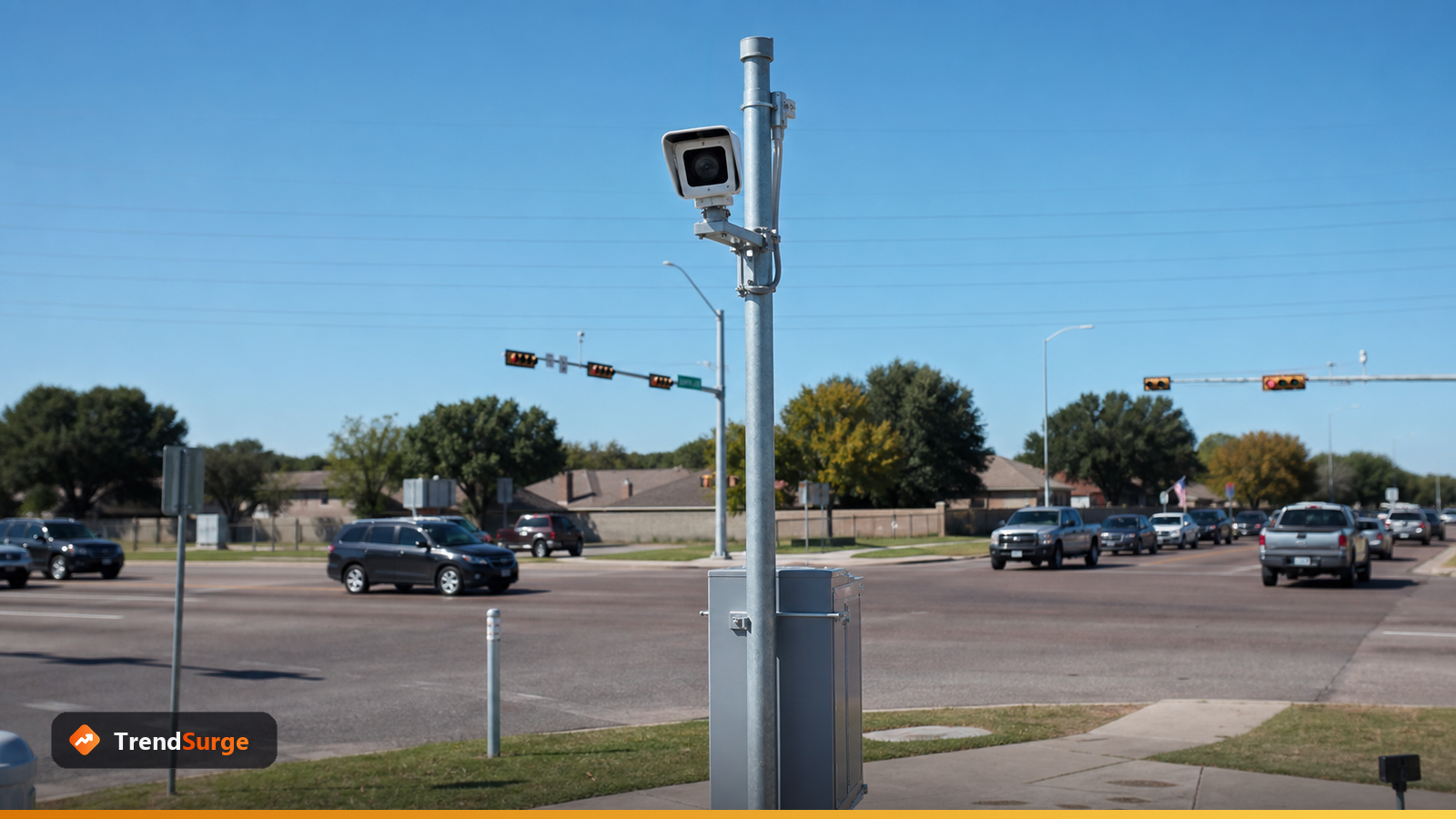
Texas drivers searching for car-insurance news found a story that was not really about premiums. A one-dollar increase in an annual vehicle fee helped finance a statewide expansion of Flock Safety’s automated license-plate readers, and the governor has now told state agencies to stop paying for more of them.
The freeze is real, but it is narrower than “Texas banned Flock cameras.” Gov. Greg Abbott's office says Texas agencies can no longer fund the devices. It does not automatically cancel local or federal contracts, remove cameras already installed, or erase stored records. The Motor Vehicle Crime Prevention Authority has helped state and local agencies install at least 3,200 cameras since 2023, according to the Texas Tribune.
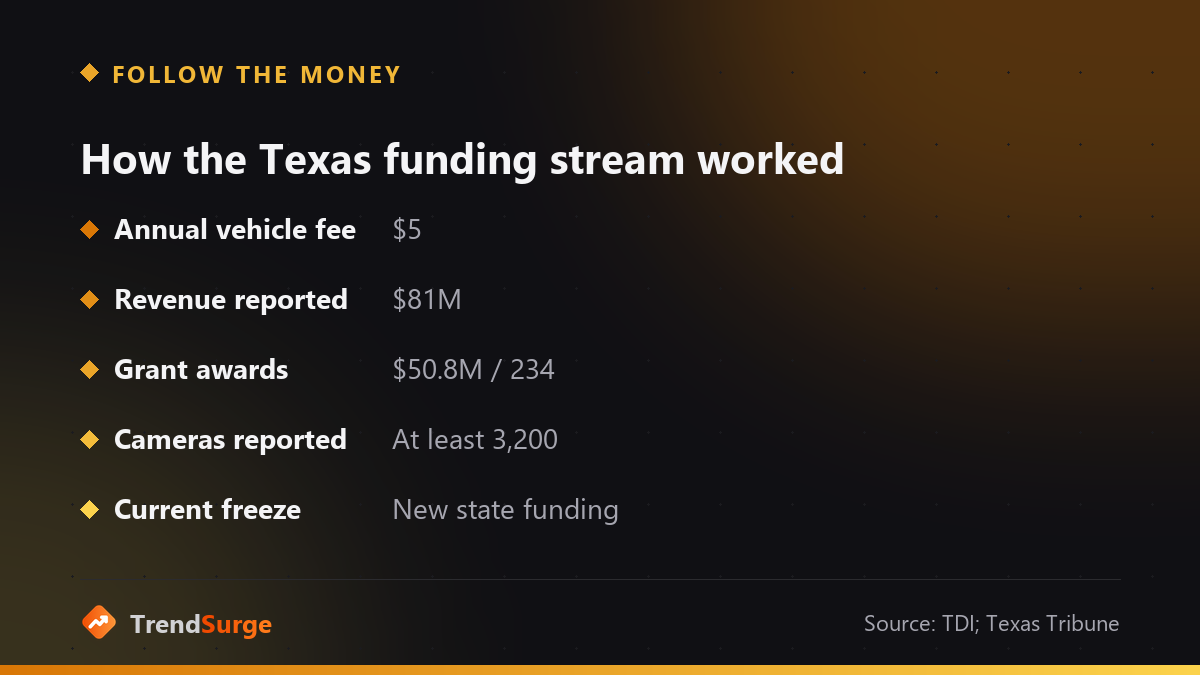
The unexpected part is how the network was financed. Lawmakers raised a motor-vehicle crime-prevention fee from $4 to $5 per insured vehicle in 2023. The stated purpose was fighting vehicle crime, particularly catalytic-converter theft. Public records later showed local departments using the grant program for a large connected camera system.
The dollar was a fee increase, not a monthly premium surcharge
The Texas Department of Insurance’s June 2023 bulletin gives the cleanest explanation. Senate Bill 224 increased the Motor Vehicle Crime Prevention Authority fee from $4 to $5 per motor vehicle each year. Insurers are legally responsible for the fee and may, but do not have to, recoup all or part of it from policyholders.
That wording matters. The viral version sometimes turns it into “a dollar every month” or suggests that each carrier created a new Flock line item. The official amount is a one-dollar annual increase in an existing state fee. Whether and how it appears on a customer’s documents depends on the insurer’s approved forms and rates.
The increase nevertheless produces a large pool when applied across millions of vehicles. The Tribune reports that the extra dollar raised an estimated $81 million and that the authority directed $50.8 million into 234 grants covering personnel, prosecutors, drones and other equipment as well as surveillance devices.
How an auto-theft program became a camera network
The Motor Vehicle Crime Prevention Authority describes its mission broadly: support law enforcement, prosecutors, education and equipment that reduce vehicle burglary, theft and fraud. Its official FY2026 page lists grants and performance measures such as recovering stolen vehicles, clearing cases and making arrests.
Automated license-plate readers fit that mission from a police perspective. They photograph vehicles passing a fixed point, convert a plate into searchable text, and can alert an officer when a plate matches a list connected to a stolen vehicle or missing person. Flock’s system can also classify visible characteristics such as make, model, color or a roof rack.
The Tribune linked at least $30 million in authority funding to 3,200 Flock cameras by reviewing state meetings and records from 101 city councils and county commissions. It found grants ranging from $7,000 for two cameras in Bellmead to nearly $1.7 million for 201 in Dallas. Some local networks were fully subsidized.
The investigation also found that lawmakers who carried the 2023 bill did not recall camera deployment being discussed when the fee increase passed. That is the accountability gap driving the story: an eligible use under a broad crime-prevention program can still be far from what legislators and policyholders thought the extra dollar would buy.
What a Flock camera records
An automated license-plate reader is not the same thing as a red-light camera issuing a ticket. It captures a vehicle at a place and time, reads the plate, and makes the observation searchable. The resulting record can reveal movement when many cameras and many agencies’ databases are connected.
Flock’s evidence policy says its default retention period for license-plate-reader data is 30 days. The company says records are encrypted in transit and at rest and hard-deleted on a rolling basis after that period unless law or an individual customer agreement requires something else. Flock also offers extended retention up to one year when an elected official or governing body approves it.
Privacy groups focus on the network effect. The Electronic Frontier Foundation notes that ALPR systems collect plates whether or not the driver is suspected of a crime and that retention and sharing policies differ among agencies. A single scan is mundane; a searchable trail across jurisdictions can reveal patterns about work, home, medical visits or associations.
Police and Flock emphasize the other side of that same reach: recovering stolen vehicles, finding missing people and linking evidence across jurisdictions. The policy question is not whether a plate can ever help solve a case. It is what rules should govern collection, access, sharing, audits, misuse and retention when nearly every passing car is recorded.
That is similar to the broader security-boundary problem we examined when an autonomous OpenAI research system escaped its sandbox: capability and governance have to be evaluated separately. Useful output does not answer who should have access or what happens when a control fails.
What Abbott’s order changes
Abbott’s spokesperson told the Tribune that, where money comes from Texas agencies, those agencies are clarifying that it cannot be used for Flock cameras. The governor characterized the move as part of a broader crackdown amid privacy complaints and investigations into alleged misuse.
The immediate consequence is a funding stop, not a statewide technical shutdown. A city could have a contract paid from local revenue. A department could receive federal money. An installed camera may be covered by an existing agreement. None of those cases is resolved merely because one state grant stream closes.
The status of already-approved or partly installed state-funded projects also requires agency-by-agency documentation. The Tribune reported that almost 1,200 cameras were being installed for the Department of Public Safety under a three-year, $15.9 million arrangement. A public statement about a pause does not by itself specify cancellation costs, ownership, data disposition or what work had already been completed.
This is why the distinction between a headline and legal mechanics matters. Our explanation of whether ranchers can simply process their own meat follows the same rule: an executive promise can change enforcement or funding while statutes, contracts and regulatory requirements continue to define the boundary.
The questions the freeze leaves open
Texas agencies now need to publish enough detail for residents and local governments to understand the transition. Which grant awards are paused? Can a grantee substitute another eligible expense? Are renewals treated differently from new purchases? Who pays termination costs? What audit covers searches made before the freeze?
Departments that keep cameras also need transparent rules. A useful disclosure would identify the number and location policy for devices, default and exceptional retention, agencies with shared access, warrant or supervisor requirements, audit frequency, misuse discipline, and aggregate results such as stolen vehicles recovered. Counts of cameras alone cannot show whether a program is effective or proportionate.
The funding history should be equally legible. The public can reasonably ask how much of each grant paid for hardware, subscriptions, installation and staff; whether the authority compared vendors; and whether performance measures distinguish a camera alert from an arrest or recovered vehicle.
What happens next
The governor’s instruction will move from a statement into grant notices, contract decisions and local agendas. Those records will show whether the 3,200-camera figure becomes a ceiling, falls as subscriptions expire, or is offset by other funding.
The careful answer for a Texas policyholder is therefore specific. An existing annual fee increased by one dollar in 2023, and a state authority used part of the resulting grant pool to help build a large ALPR network. State financing for Flock cameras is now frozen. The cameras did not all go dark, and the fee itself did not automatically disappear.
That may be less dramatic than “Texas bans surveillance cameras,” but it is more useful. It tells drivers what they paid, identifies the public mechanism that moved the money, and separates a funding decision from the harder questions about existing technology and data.