Key Takeaways
- The 25th flight lasted 72 minutes and reached Mach 1.2 at approximately 49,000 feet on August 21.
- Earlier testing had already reached the target cruise conditions of Mach 1.4 and 55,000 feet.
- The accompanying chase aircraft's sonic booms masked the X-59's noise during the flights so far.
- Acoustic validation will measure the X-59's sound before community-response research informs regulators.
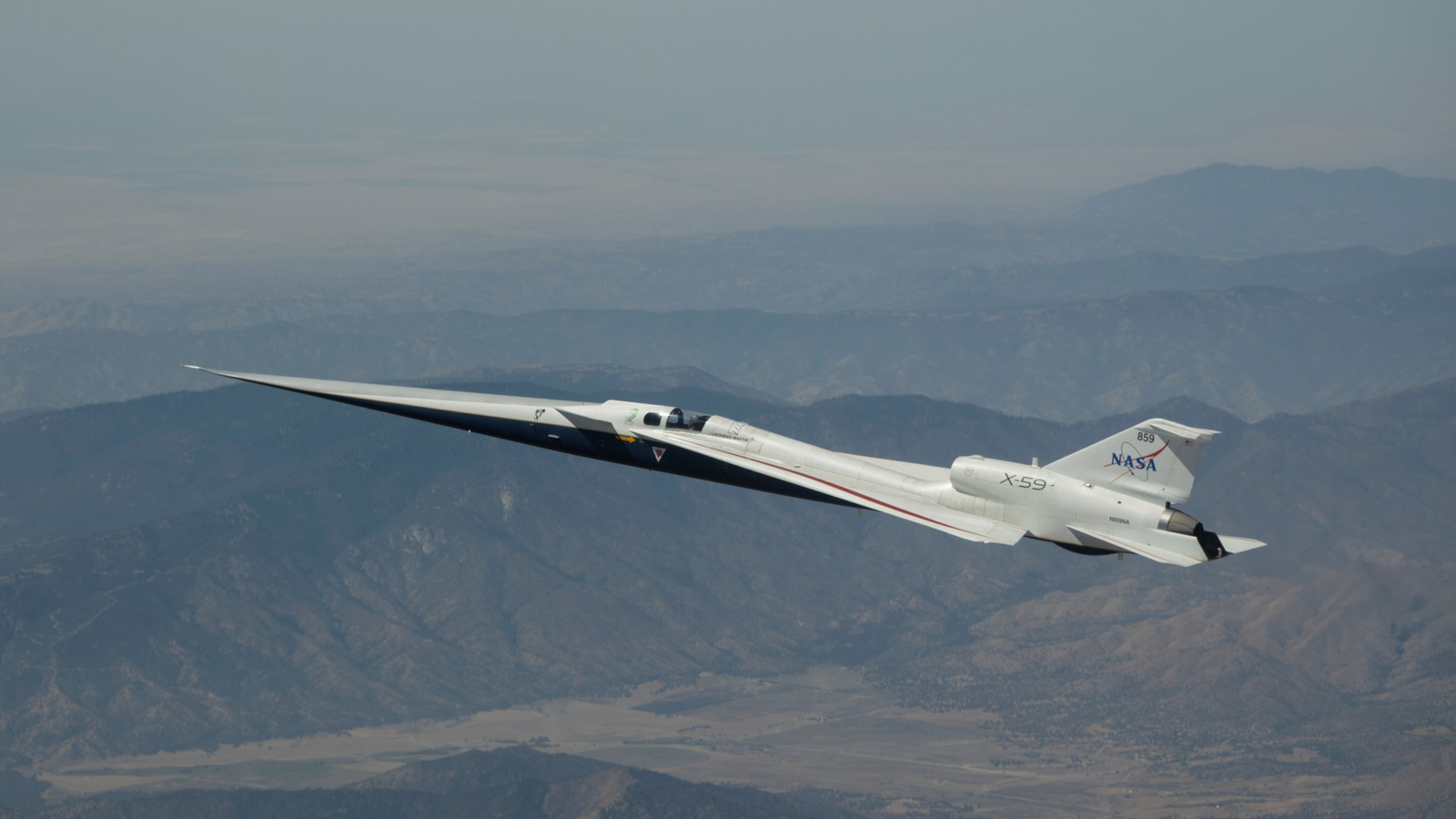
NASA’s X-59 has completed 25 test flights and already reached its intended cruise conditions of Mach 1.4 at 55,000 feet. The important qualification: those flights have tested the aircraft’s performance, while the campaign to measure its promised quiet sonic thump is still ahead.
In a September 4 update, NASA said the 25th flight actually occurred on August 21. The distinction matters if you saw the milestone presented as a new flight this week—or as proof that quiet supersonic travel has already been demonstrated over American communities.
Hero photograph: NASA/Jim Ross, X-59 over the Mojave Desert on August 18, 2026. Image source · NASA editorial reuse guidelines. Cropped and resized.
What the 25 flights have actually established
The clearest result is that the unusual aircraft is behaving much as its designers predicted. According to NASA’s flight update, flight data agree closely with simulations on controllability, stability margins, and the loads that bend and twist an aircraft in flight.
Those are separate checks. Controllability concerns how the aircraft responds to the pilot. Stability margin concerns how near it gets to an unstable condition. Flight loads concern the physical stresses on the structure. Passing one would not automatically establish the others, which is why a headline speed is an incomplete account of testing.
NASA also reported no unexpected instability or excessive vibration in response to aerodynamic forces. Engineers compare live aircraft data with simulated predictions using a real-time digital twin. The value of that comparison is practical: each completed test strengthens or challenges the assumptions used to plan the next one.
This remains NASA’s assessment of its own experimental program. The September update supplies specific performance results, but it does not supply a completed community noise study or an approval for commercial passenger service.
Why flight 25 was slower than the target speed
The August 21 flight departed NASA’s Armstrong Flight Research Center in Edwards, California. It lasted 72 minutes, reached Mach 1.2, and climbed to approximately 49,000 feet. Those figures are below the Mach 1.4 and 55,000-foot cruise conditions NASA says the aircraft reached earlier in its test schedule.
That is not a contradiction. A test program does not need to set a speed record on every flight. NASA says much of the remaining performance work involves checking the aircraft throughout its flight envelope, including conditions at lower speeds and altitudes.
For readers following aviation milestones, the useful question is therefore what a flight was designed to test. A faster run can establish one operating condition; a slower run can answer a different question about handling or systems. Comparing only the maximum speed can make planned, informative work look like a setback.
The same distinction applies to the flight count. Twenty-five is a measure of activity. The stronger evidence is the list of conditions tested, the agreement with predictions, and the remaining questions. All three appear in NASA’s account.
The chase plane explains the biggest caveat
Every X-59 test flight so far has included a chase aircraft monitoring it. NASA explicitly says the chase aircraft’s sonic booms masked whatever noise came from the X-59.
That prevents an easy inference from the milestone: going supersonic does not, by itself, demonstrate that the X-59 produces the intended sound on the ground. Nor would an ordinary recording of a two-aircraft flight cleanly isolate one aircraft’s contribution.
The X-59 was shaped to spread out the pressure effects that otherwise create a loud sonic boom, with the aim of producing a quieter thump. Its geometry is a design intended to achieve that outcome. Acoustic validation is the phase that will test the outcome with instruments.
NASA describes that next campaign as complex and demanding. Ground and airborne tools will measure and characterize the sound. Until those measurements are reported, the responsible description is that the aircraft is progressing toward the quiet-flight demonstration—not that the final noise result is already known.
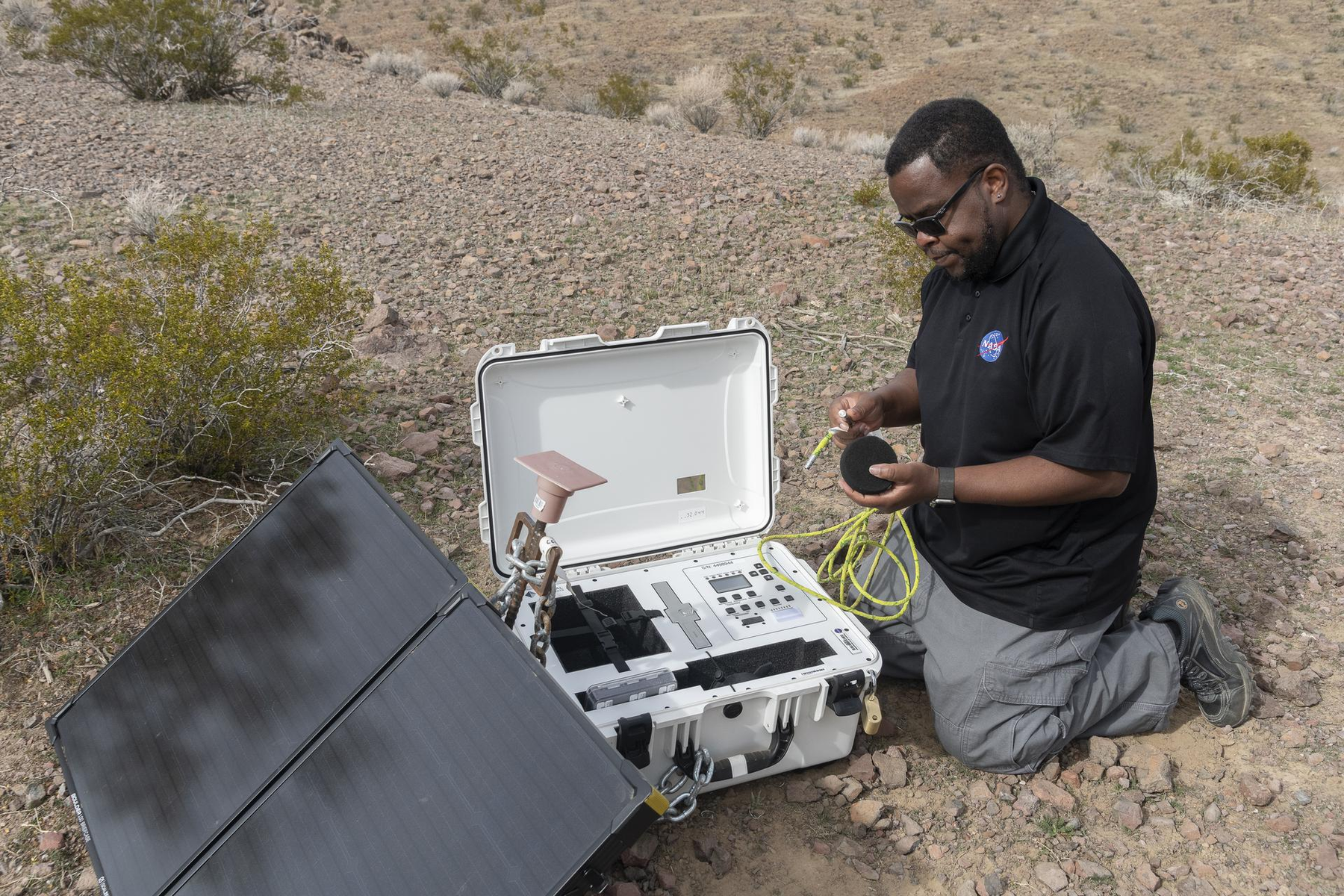
Listening accurately is an engineering project of its own
NASA’s earlier CarpetDIEM account explains why acoustic validation requires more than placing a microphone under the flight path. In that preparatory work, researchers deployed ten microphone stations along a 30-mile stretch of desert and used F-15 and F-18 aircraft to test the equipment and procedures.
The team had to establish how to deploy the recorders, retrieve their data, and operate them across an extended campaign. The systems also needed to cope with desert temperatures and wildlife. Those details affect whether measurements will remain dependable from flight to flight.
The preparation included using aircraft position broadcasts to trigger recording automatically. That reduces the need to station a person at each instrument. NASA also tested the systems with both loud and softer booms, including special F-18 maneuvers. Those were equipment rehearsals using other aircraft, not noise measurements of the X-59.
The 2024 account described an expected X-59 level of about 75 perceived loudness decibels. That was a target, not a result from the 25-flight update. Keeping the word “expected” attached to it avoids turning a design objective into a measured achievement.
Small fixes are part of the milestone
The September report includes work between flights as well as what happened in the air. Pilots, engineers, and maintenance teams reviewed data, made minor control-software adjustments, and resolved a problem in which nuisance alerts were being interpreted as caution warnings.
NASA says the top-mounted inlet feeding the single GE-F414 engine has performed as expected across maneuvers and operating conditions. That is another specific system result, separate from how the aircraft eventually sounds to people below it.
For a research aircraft, this combination matters: predictable behavior allows the team to proceed to more demanding measurements. It would be misleading to describe the program as finished because the plane flies, but equally misleading to treat preliminary flight testing as irrelevant because the acoustics are not yet settled.
What happens next—and what travelers should watch
NASA’s next major phase is acoustic validation, planned for later this year in the September 4 account. After demonstrating the sound characteristics, the Quesst mission intends to gather people’s reactions to overhead flights and share those findings with national and international regulators.
That sequence separates three questions: can the aircraft operate as designed, how loud is it, and how do communities respond? The flight update makes progress on the first and points toward the second. It does not answer the third.
Travelers should watch for published noise measurements and the design of community-response studies, rather than treating the next flight count as a promise of a new airline route. The aircraft is a research tool; this update offers no ticket price, passenger-service launch date, or guaranteed regulatory decision.
The distinction between launch milestones and useful science also appears in our Roman telescope checkout explainer. For an activity you can do now, our September night-sky guide covers viewing opportunities rather than future aircraft research.
Quick poll
Which X-59 result would you most want to see next?
Our take: measured sound and community response answer different questions; both matter.
FAQ
When was the X-59’s 25th flight?
It took place on August 21, 2026. NASA published the milestone account on September 4.
Has the X-59 reached its target cruise speed?
Yes. NASA says earlier tests reached Mach 1.4 at 55,000 feet; flight 25 reached Mach 1.2 at approximately 49,000 feet.
Have the 25 flights proved the quiet sonic thump?
No completed acoustic-validation result was announced. NASA says the chase aircraft’s sonic booms masked X-59 noise during the flights so far.
Does this mean supersonic passenger flights are ready?
No. Quesst is a research mission whose sound measurements and community-response findings are intended to inform regulators. The update does not announce commercial passenger service.