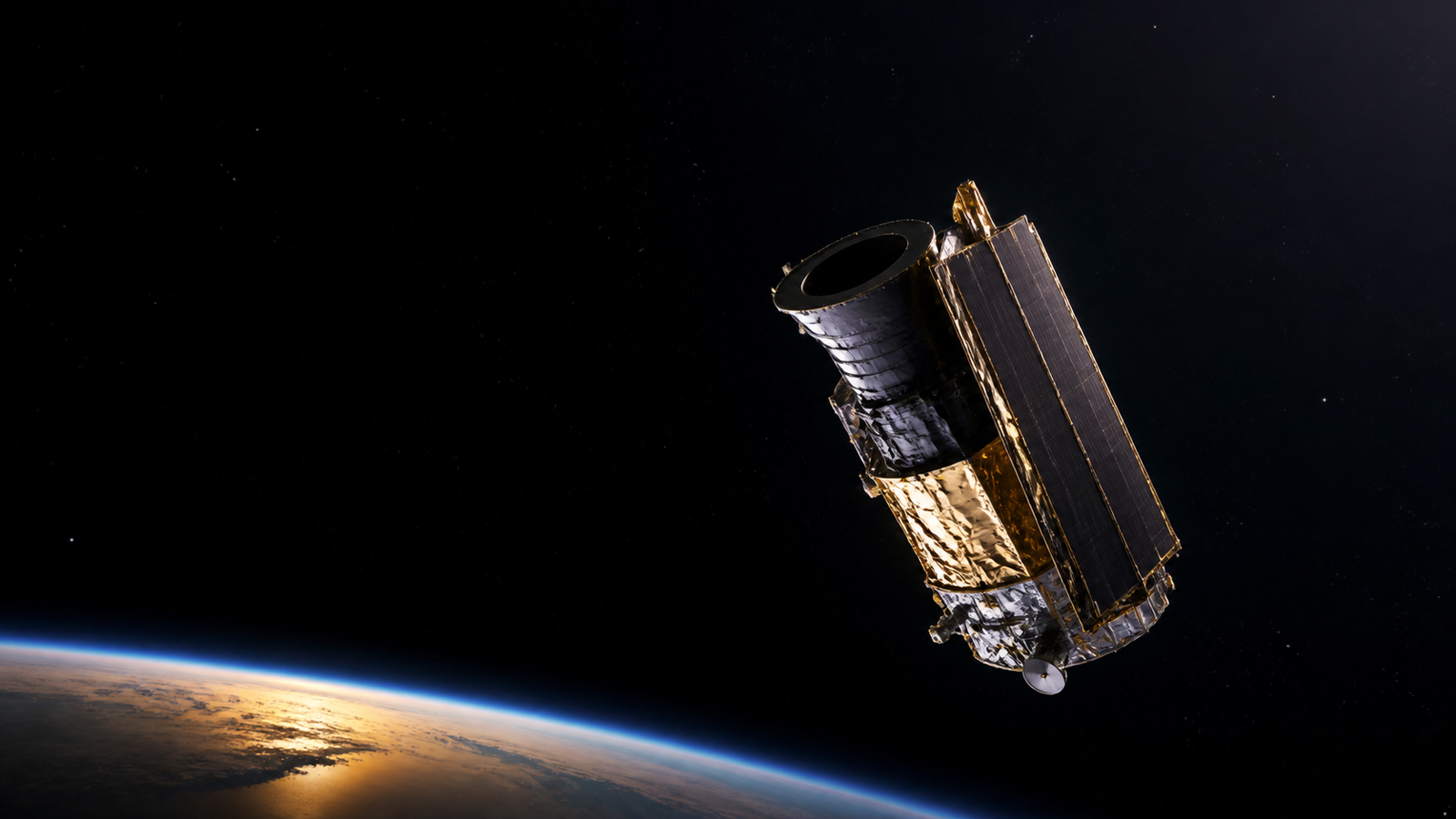
NASA's Nancy Grace Roman Space Telescope launched successfully and is communicating on its way to the Sun-Earth L2 region, but it is not doing survey science yet. The next roughly three months are for travel, deployment, activation, calibration, and testing; NASA anticipates releasing the first images in early 2027 if commissioning proceeds as planned.
A SpaceX Falcon Heavy lifted Roman from Launch Complex 39A at Kennedy Space Center at 7:26 a.m. EDT on Aug. 30, 2026. The observatory separated from the rocket’s second stage at about 7:57 a.m. and began flying independently toward an operating region roughly one million miles from Earth.
That distinction matters because launch footage can make a mission feel complete. For an observatory, reaching space is the handoff from the launch team to a long chain of engineering checks. Beautiful pictures and scientific conclusions come only after the spacecraft proves it can point, cool, communicate, collect stable data, and calibrate both instruments.
What NASA had confirmed after launch
The ground team began receiving Roman telemetry seven minutes after liftoff. NASA’s postlaunch release says Falcon Heavy performed as expected and released the observatory 31 minutes into flight. The agency also confirmed deployment of the solar panels and lower instrument sun shade one hour and 23 minutes after launch.
Those are not minor housekeeping details. The solar array provides power and also helps shield the telescope thermally. Stable temperature is essential because tiny changes in an optical system can alter how light lands on detectors. Communication gives controllers the data needed to understand spacecraft health and send commands for the next steps.
NASA said the high-gain antenna and visor-like deployable aperture cover were scheduled to deploy in the following days, along with the first of two midcourse corrections and activation of the Coronagraph Instrument. As of the Aug. 30 release, those were upcoming milestones rather than completed events. Treating a planned step as finished would get ahead of the mission log.

Roman launched about nine months ahead of its formal readiness date after the observatory was completed early and NASA coordinated an accelerated opportunity. An early departure does not justify rushing commissioning. The tests are how the team learns whether years of work on the ground translated into stable performance in space.
Why Roman is going to L2
Roman is traveling toward an orbit around the second Sun-Earth Lagrange point, called L2. Near that region, the Sun and Earth remain in roughly the same direction from the spacecraft. That geometry helps an observatory manage sunlight, heat, power, and communications while maintaining access to a large area of sky.
L2 is not a parking spot where the telescope remains motionless. Roman will move in a broad orbit around the region, as the James Webb Space Telescope and ESA’s Euclid mission do. ESA describes Roman’s destination as nearly 1.5 million kilometers from Earth and notes that the observatory can access almost 12% of the sky at a given time from its operating geometry.
The trip and checkout are planned together as an approximately 90-day commissioning period. Engineers can use the journey to deploy hardware and characterize systems before the observatory begins its formal survey program.
Roman’s advantage is width at high resolution
Roman has a 2.4-meter primary mirror, the same diameter class as Hubble’s, but its defining feature is not simply a bigger mirror. Its Wide Field Instrument is a 300-megapixel infrared camera built from 18 detectors. NASA says the observatory combines Hubble-like sharpness with a field of view at least 100 times larger and is designed to survey the universe up to 1,000 times faster.
The comparison needs a qualifier. Roman is not 1,000 times better at every possible observation and is not replacing Hubble, Webb, or Euclid. It is optimized to cover large areas repeatedly at high resolution. Other observatories can examine narrower targets, different wavelengths, or individual objects in greater detail.
That survey scale changes the questions astronomers can ask. Instead of selecting only a small number of galaxies, supernovas, or stars, researchers can study populations across wide regions and watch how objects change over time. Repeated observations can reveal motion, brightness changes, explosions, and short-lived lensing events that a single static image would miss.
The three headline science programs share the same sky
Roman’s best-known goals involve dark energy, dark matter, and exoplanets. Dark energy is the name for whatever is driving the accelerating expansion of the universe. Dark matter is inferred from gravitational effects on galaxies, clusters, and light even though it does not emit light that ordinary telescopes can see directly.
Roman will not collect either substance. It will map how galaxies are distributed across cosmic time, measure thousands of Type Ia supernovas, and study weak gravitational lensing, the subtle distortion created when mass bends light. Combining several measurement methods can test whether they point to the same history of cosmic expansion and structure.
For planets, Roman will use complementary effects. Microlensing occurs when the gravity of a foreground object briefly magnifies a background star, potentially revealing planets far from their host stars or even free-floating worlds. NASA expects more than a thousand planets from that method. The same repeated observations may identify around 100,000 transiting planets when worlds pass in front of their stars and create small dips in brightness.
Those numbers are forecasts based on survey design and simulations, not discoveries already made. Roman’s Coronagraph Instrument is also a technology demonstration intended to directly image Jupiter-like planets and test methods useful to future missions. It is not a claim that Roman will photograph an Earth twin at launch.
The data system is part of the mission
NASA expects Roman to return about 1.4 terabytes of data per day, the highest daily rate so far for one of its astrophysics missions. A wide survey produces more than attractive panoramas: it creates an archive that must be calibrated, transmitted, searched, and made usable for many research teams.
Automated pipelines will be necessary to identify changing objects and prepare reliable data products. NASA expects machine learning, artificial intelligence, and citizen scientists to help flag potentially significant findings for astronomers to examine. That does not make discoveries automatic. Algorithms can triage an enormous stream; researchers still need validated calibration, follow-up, and analysis.
The primary mission is planned for at least five years, and the observatory is designed for another five. Longer operation would add a valuable time baseline, but the extension is a design goal rather than a guaranteed decade of data.
What to watch next without mistaking engineering for discovery
The meaningful near-term updates are trajectory corrections, antenna and aperture-cover deployment, instrument power-on, thermal stabilization, focus and pointing tests, and calibration. An early engineering image may confirm that a detector works without yet supporting a scientific claim.
NASA anticipates first images in early 2027. ESA says the first science image release will mark the start of science operations after commissioning, while STScI’s published observing windows assume an Aug. 30 launch and 90-day checkout and remain subject to scheduling changes. That is a planning baseline, not a promise that no technical issue can move the date.
For more on the infrastructure behind modern discovery, see our Nvidia AI-computing explainer. Our Meta Connect 2026 preview separates confirmed announcements from expectations, and the Apple September event guide applies the same evidence boundary to consumer hardware.
Roman’s verified status as of Aug. 31 is successful launch, separation, communications, and early deployment—not completed commissioning and not scientific discovery. NASA’s Roman blog is the appropriate source for milestones after that cutoff.