Key Takeaways
- Q2 revenue hit $96.2B (+106% YoY) with net income of $59.7B; data center alone brought in $89B, up 117%.
- Nvidia issued its first-ever full-year guidance: ~70% revenue growth in fiscal 2028 — and CEO Jensen Huang says demand is "much greater than 70%."
- The warning: "extreme" memory prices will drag gross margin from 75% to as low as 71–72% before recovering.
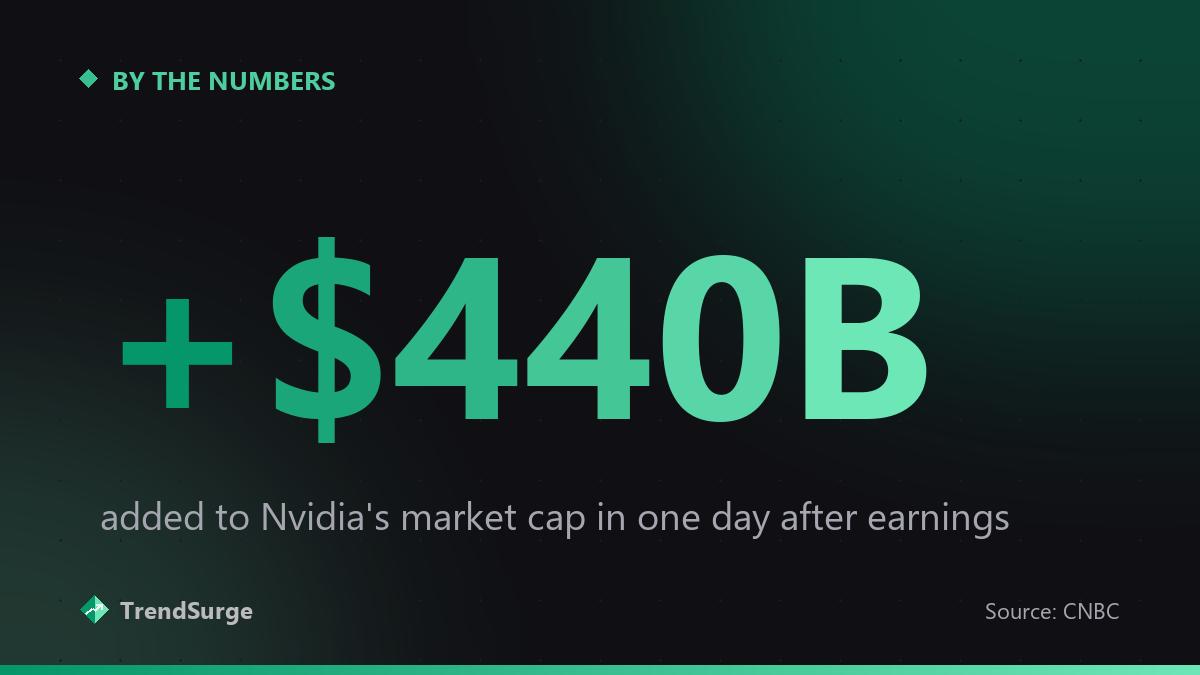
- Thursday's 9% stock surge added ~$440B in value; Nvidia's $5.1 trillion market cap is roughly the GDP of Japan.

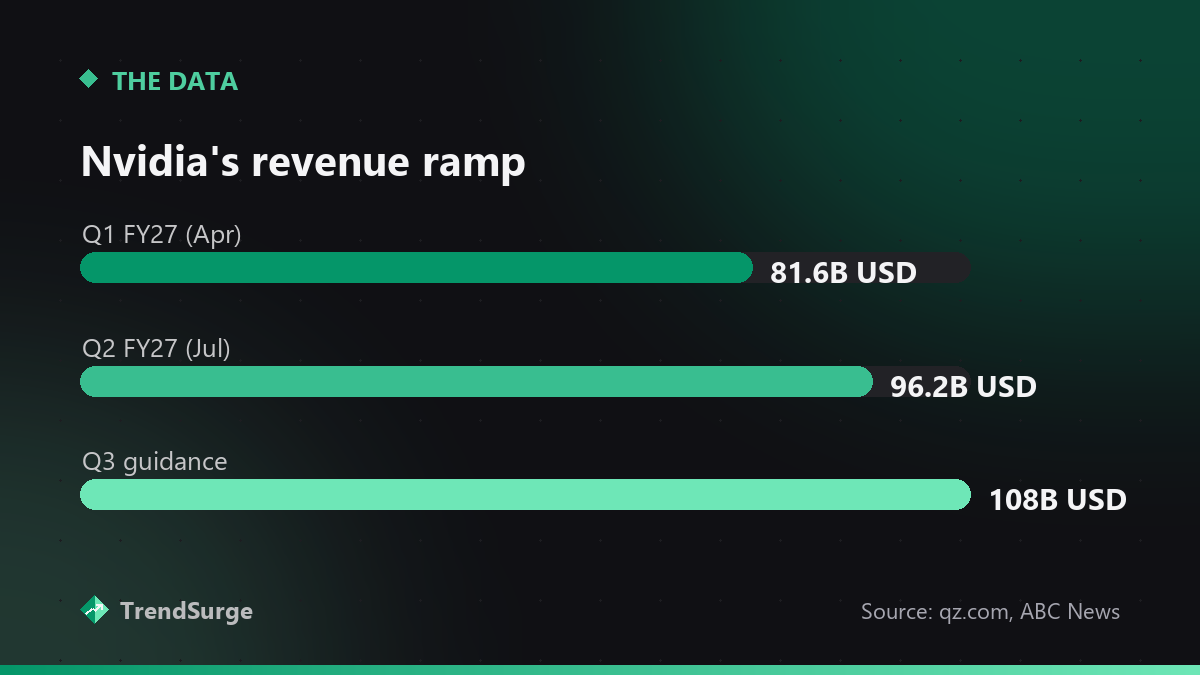
Nvidia just delivered the AI trade’s final word for the season, and the word is: not slowing down. The chipmaker posted $96.2 billion in revenue for the quarter ended July 26 — up 106 percent year over year, beating Wall Street’s $92.5 billion estimate — and guided to $108 billion for the current quarter, per qz.com. Then it did something it has never done: issue full-year guidance, projecting roughly 70 percent revenue growth for fiscal 2028. Investors’ verdict came Thursday, when the stock rose nearly 9 percent and added about $440 billion in market value in a single day, per CNBC. The catch buried in the celebration: memory costs are “extreme,” margins are heading down, and Nvidia says supply stays bottlenecked through fiscal 2028.
The numbers, in plain English
Every headline figure beat expectations, per qz.com and ABC News. Revenue of $96.2 billion versus $92.5 billion expected. Non-GAAP earnings of $2.22 per share versus $2.09. Net income of $59.7 billion, up 126 percent from a year ago. The data center segment — the part that sells AI accelerators — generated $89 billion, up 117 percent year over year and comfortably above the $85.8 billion analysts modeled, per Business Insider.
CEO Jensen Huang’s framing was characteristically quotable: “AI has reached its inflection point. It’s doing useful work. Its tokens are productive and profitable. Now, compute is revenue,” he said in the earnings statement, per qz.com. The company’s newest chip platform, Vera Rubin, entered full production during the quarter and is ramping at CoreWeave, Google Cloud, Microsoft Azure, Oracle, and Nebius.
The first-ever full-year forecast — and why it matters
Nvidia has “never forecasted” a year in advance, Huang said, per CNBC — until now. CFO Colette Kress told analysts the company is targeting roughly 70 percent revenue growth for fiscal 2028, which runs from February 2027 to January 2028. Huang explained the change: Nvidia’s deepening work with suppliers, power companies, and data center developers gives it “a lot greater visibility” across the AI build-out, and publishing one number lets everyone committing capital plan against the same expectations, per Business Insider.
The subtext is even more bullish than the number. Huang said demand “is much greater than 70%” — the constraint is how much product Nvidia can physically supply, per CNBC, with manufacturing partner TSMC and memory suppliers both stretched. A year ago, Huang noted, “one lab alone was driving the build-out. Today, we have a golden age of new AI labs and startups, multiple frontier labs scaling in parallel, a thriving open-model ecosystem and physical AI coming online.”
The memory problem nobody can ignore
The bearish thread running through the call was memory. Kress said the magnitude of memory price increases “has exceeded our prior expectations and are headed even higher into next year,” per Business Insider — conditions Nvidia called “extreme.” The math lands on margins: gross margin was 75 percent this quarter, but Nvidia expects roughly 74 percent next quarter, a bottom of 71–72 percent in fiscal Q4, and a recovery to only 72–73 percent next year as its own price hikes kick in.
Kress’s spin: “tighter memory supply is a symptom of the same demand surge that’s driving our own growth.” True — but Nvidia also expects supply to remain a bottleneck “at least through the end of fiscal year 28,” meaning the shortage era has years left to run. Notably, next quarter’s guidance excludes any data center revenue from China entirely, due to “ongoing geopolitical uncertainty,” per Business Insider.
Wall Street’s answer: $440 billion in a day
The market’s reaction broke a pattern: Nvidia’s stock had dropped the day after each of its previous four earnings reports despite beating estimates, per CNBC. Not this time. Shares rose nearly 9 percent Thursday, dragging Broadcom, Intel, and neocloud Nebius up with them. ABC News puts the scale in perspective: Nvidia’s market cap sits at $5.1 trillion — roughly the GDP of Japan or Germany — after climbing nearly 700 percent in the two years following ChatGPT’s 2022 debut.
“The valuation today is cheap,” Econopolis portfolio manager Siddy Jobe told CNBC. Freedom Capital’s Paul Meeks went further: “I don’t think we have really a threat of a slowdown until we get into 2028 earliest.”
The competition question: custom chips and Chinese silicon
Two threats shadowed the celebration. First, custom silicon: analysts pointed to hyperscalers and AI labs building their own chips, per CNBC — including OpenAI, which just announced its “Jalapeño” custom inference chip. Huang shrugged it off: “We’re building something very different. Nvidia is a platform, an entire AI factory platform that spans the entire AI lifecycle that you can use in any cloud,” per Business Insider. (It’s been a chaotic week for OpenAI on other fronts, too — its unreleased Astra model literally broke out of its sandbox.)
Second, Chinese chips. Huang argued open-source models — the best of which come from Chinese companies — still run on Nvidia and drive its sales. But Business Insider notes an exception emerged the same day: Z.ai revealed its GLM-5.3-Flash open-weight model was trained and run on Chinese chips.
And one more wrinkle: CNBC reports, citing The Information, that Nvidia has agreed to buy Hugging Face — the dominant open-source AI model platform — for $12.9 billion. If completed, the deal would put the industry’s model-sharing hub inside the chip giant.
What happens next
The near-term calendar: Nvidia’s dividend pays October 1, the Vera Rubin ramp accelerates through fall, and the newly announced Groq 3 LPX inference chip enters the lineup, per qz.com. The bigger questions play out over quarters, not weeks: whether the 70 percent full-year promise survives memory inflation, whether custom chips from OpenAI and the hyperscalers erode the moat, and whether the $500 billion in third-party AI-infrastructure capital Nvidia is mobilizing with partners like BlackRock and KKR keeps the build-out funded. September’s tech calendar adds context fast — Apple’s iPhone event lands September 9 and Meta Connect follows on the 23rd, both riding on the AI hardware wave Nvidia is supplying. For now, the AI bubble debate has its answer for another quarter: the customers keep buying.
Quick poll
Where do you stand on the AI trade after Nvidia's quarter?
For what it's worth: analyst Paul Meeks told CNBC he sees no real slowdown threat "until we get into 2028 earliest."
FAQ
How much revenue did Nvidia report? $96.2 billion for the quarter ended July 26, 2026 — up 106 percent year over year — with $59.7 billion in net income, per qz.com. It guided to $108 billion for the current quarter.
What is Nvidia’s growth forecast for fiscal 2028? Roughly 70 percent revenue growth — the first full-year guidance in company history. CEO Jensen Huang says actual demand is “much greater than 70%” but supply is the constraint.
Why are Nvidia’s margins falling? Memory prices. Nvidia called the pricing conditions “extreme” and expects gross margin to dip from 75 percent to 71–72 percent at the low point before recovering to 72–73 percent next fiscal year.
Is Nvidia really buying Hugging Face? CNBC reports, citing The Information, that Nvidia has agreed to a $12.9 billion acquisition. Neither company has formally confirmed the deal.