Apple TV’s U.S. subscription price changed again on Aug. 28. The service now advertises $14.99 a month after a seven-day trial, while Apple One Individual has risen to $21.95. Those are the numbers in the headline, but they are not the only prices a subscriber should compare.
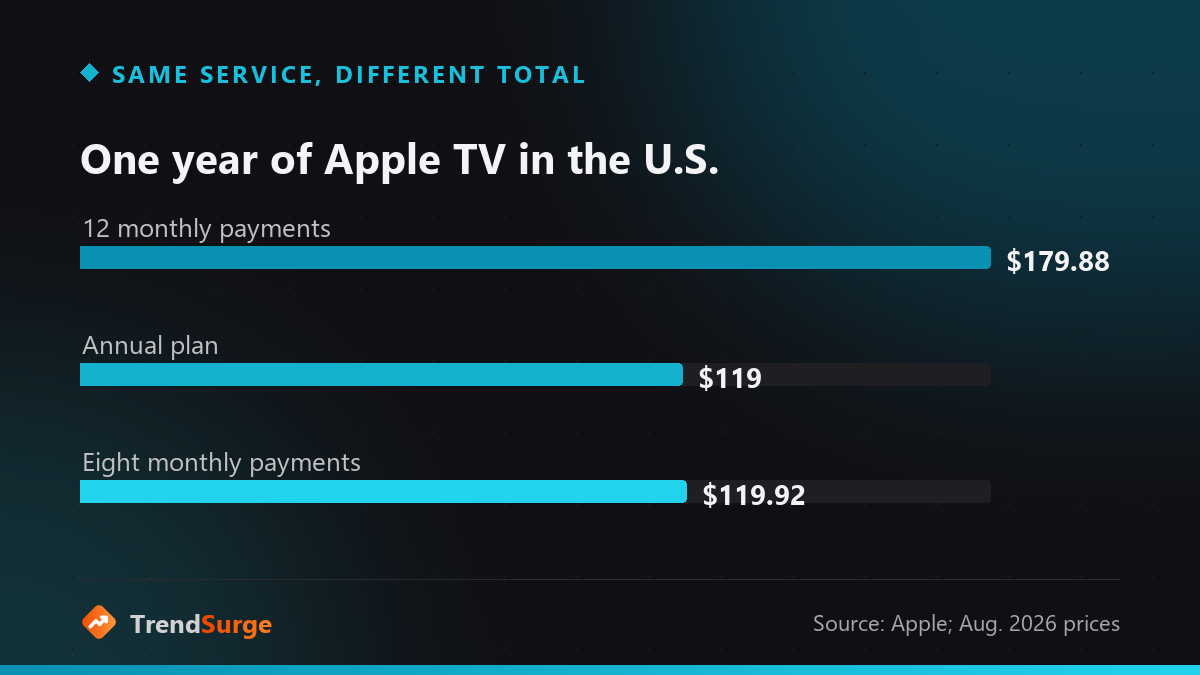
The simple answer is that month-to-month Apple TV now costs $179.88 over a full year, while the reported $119 annual plan costs $60.88 less. Apple One Individual is not automatically the better deal: at $21.95 a month, it makes sense only if you value its Music, Arcade and 50GB iCloud+ components. A U.S. Apple TV-and-Peacock bundle can even cost the same $14.99 as Apple TV alone.
The useful decision is therefore not “accept or cancel.” It is to identify which billing route matches what the household actually watches and uses. Apple’s menu now rewards commitment and bundling much more than the large monthly price suggests.
The prices that changed
Apple confirmed a U.S. monthly increase from $12.99 to $14.99. MacRumors, TechCrunch and other outlets report that the annual subscription moved from $99 to $119 and Apple One Individual rose from $19.95 to $21.95. New subscribers saw the higher price immediately; existing subscribers are supposed to receive notice about a month before the new charge.
Apple’s own pages now display $14.99 for Apple TV and $21.95 for Apple One Individual. The company says Family and Premier Apple One plans remain $27.95 and $39.95 after those tiers increased earlier alongside Apple Music.
The monthly Apple TV jump is $2, or about 15.4%. The annual increase is $20, or about 20.2%. Both can be true because the annual plan started with a larger discount.
Apple TV launched at $4.99 a month in 2019. Its U.S. monthly price moved to $6.99 in 2022, $9.99 in 2023, $12.99 in 2025 and $14.99 in 2026. That history explains why the latest change feels larger than two dollars: the current monthly price is three times the launch price.
The annual plan is the overlooked option
Twelve monthly payments at $14.99 total $179.88. Paying $119 for a year reduces the effective monthly cost to about $9.92. The difference is $60.88, roughly four months at the new monthly rate.
The break-even point is just under eight months. Someone who expects to subscribe for eight or more months in the next year pays less with the annual option, assuming the annual price and eligibility shown at purchase match the reported U.S. rate. Someone who watches only one or two shows and cancels for long stretches can still spend less by rotating the monthly service.
That makes behavior more important than the sticker price. A person who says “I cancel after every season” but stays enrolled all year is paying the worst of both models: the flexibility premium without using the flexibility.
The timing also matters for readers following Apple’s hardware calendar. The company has scheduled its Sept. 9 event, covered in our iPhone 18 and foldable iPhone preview. A new device can include three free months of Apple TV when redeemed within Apple’s stated window, so an eligible hardware buyer should check that offer before starting a paid annual plan.
Apple One is a usage test, not a loyalty test
Apple One Individual includes Apple TV, Apple Music, Apple Arcade and 50GB of iCloud+. Apple lists their separate prices as $14.99, $11.99, $6.99 and $0.99, a total of $34.96. The bundle at $21.95 is $13.01 less than buying all four separately.
That impressive percentage is relevant only if the subscriber would pay for those services anyway. If Apple TV is the only wanted product, Apple One costs $83.40 more per year than the $179.88 monthly-TV total and $144.40 more than the $119 annual-TV plan. Unused services are not savings.
The bundle becomes easier to justify for someone already paying for Apple Music. Music plus monthly Apple TV now totals $26.98, so Apple One Individual is $5.03 cheaper and adds Arcade and 50GB of iCloud+. Conversely, someone on a discounted student Music plan should not assume the same math. Apple says the Apple Music Student Plan includes Apple TV access, making a second TV subscription unnecessary for an eligible student.
Family and Premier plans require a different comparison. Apple says Family can be shared with up to five other people and includes 200GB of iCloud+, while Premier adds News+, Fitness+ and 2TB. Household sharing can lower the effective per-person price, but storage needs and who is actually in the Family Sharing group matter more than a simple division by six.
The Peacock bundle creates the strangest comparison
Apple’s U.S. TV pages advertise a joint Apple TV and Peacock offer. The bundle with ad-supported Peacock Premium starts at $14.99 a month, exactly the same price as a standalone monthly Apple TV subscription. A Premium Plus version is listed at $19.99.
For an eligible U.S. viewer who wants both catalogs, the first bundle makes standalone month-to-month Apple TV difficult to defend on price alone. Apple says the $14.99 option saves 37% compared with separate subscriptions. The tradeoff is that Peacock Premium includes advertising, and Apple notes that bundle offers do not include a free trial or annual plan.
Availability and existing billing arrangements can complicate the switch. App-store, carrier or promotional subscriptions may renew on different dates. A reader should confirm the offer shown in the account rather than assume every Apple page or third-party billing channel presents the same route.
What the higher price includes — and what it does not
Apple’s current U.S. service pitch includes original shows and films, Formula 1 races, MLS matches and Friday Night Baseball at no extra cost. The subscription remains ad-free for Apple Originals and supports Family Sharing for up to six people total.
It does not make everything inside the Apple TV app free. The app also surfaces rentals, purchases, third-party channels and other streaming services. A recognizable movie tile can still carry a separate price. The hardware called Apple TV 4K is also a different product from the Apple TV streaming subscription.
That naming confusion becomes more expensive after a price hike. Before accepting a charge, check whether it is for the Apple TV service, an Apple One bundle, a channel subscribed through the app, or purchased content.
The competitive calendar matters too. Our Netflix September guide shows why viewers often rotate services around specific releases instead of treating every subscription as permanent. The best Apple option can change month to month when the shows a household values move on or off its active list.
A five-minute subscription audit
Open the account’s subscription list and record the renewal date, billing channel and actual price. Then look back at the last three months of use rather than relying on memory. If Apple TV was used briefly around one series, set a cancellation reminder and use monthly access. If it stayed active continuously, compare the annual offer.
Next, check for overlapping benefits. An Apple Music student subscription may already include TV. Apple One may already cover a service billed separately until a trial ends. A new Apple device may carry a three-month offer. Family Sharing may let the household consolidate without sharing private files or viewing history.
Finally, judge bundles by the services that would survive individually. Giving every included icon its retail value exaggerates savings when several would be canceled on their own.
The next renewal notice to check
Existing subscribers should watch for Apple’s renewal notice and confirm the date the higher price reaches their account. The annual option, bundles and promotional eligibility can change, so the checkout screen is the final source for an individual purchase.
The broad business signal is clear: Apple is using originals and live sports to support a premium streaming price while making the annual plan and ecosystem bundles comparatively attractive. The consumer answer is more personal. $14.99 is the attention-grabbing number, but the real yearly cost can be $119, $179.88, $263.40 for Apple One Individual, or much less for someone who cancels between shows.
The price hike is real. Paying it twelve times by default is optional.