Ridley Scott and Josh Brolin say the real subject of The Dog Stars is not the apocalypse but dependence: practical skills keep people alive, while trust and connection give survival a purpose. That is the filmmakers' stated reading of the movie, not proof that every viewer or critic will find the finished film equally persuasive.
The film opened in theaters Aug. 28, 2026, with the recognizable machinery of a large-scale survival thriller: a flu-ravaged society, a defended airstrip, scarce supplies, armed suspicion, and a radio signal that may justify leaving safety. Scott’s and Brolin’s interpretation comes from an Aug. 27 interview published by The Walt Disney Company, which owns 20th Century Studios. It is valuable first-party evidence about intent, but it is also studio promotion and should be labeled that way.
The premise turns loneliness into a physical choice
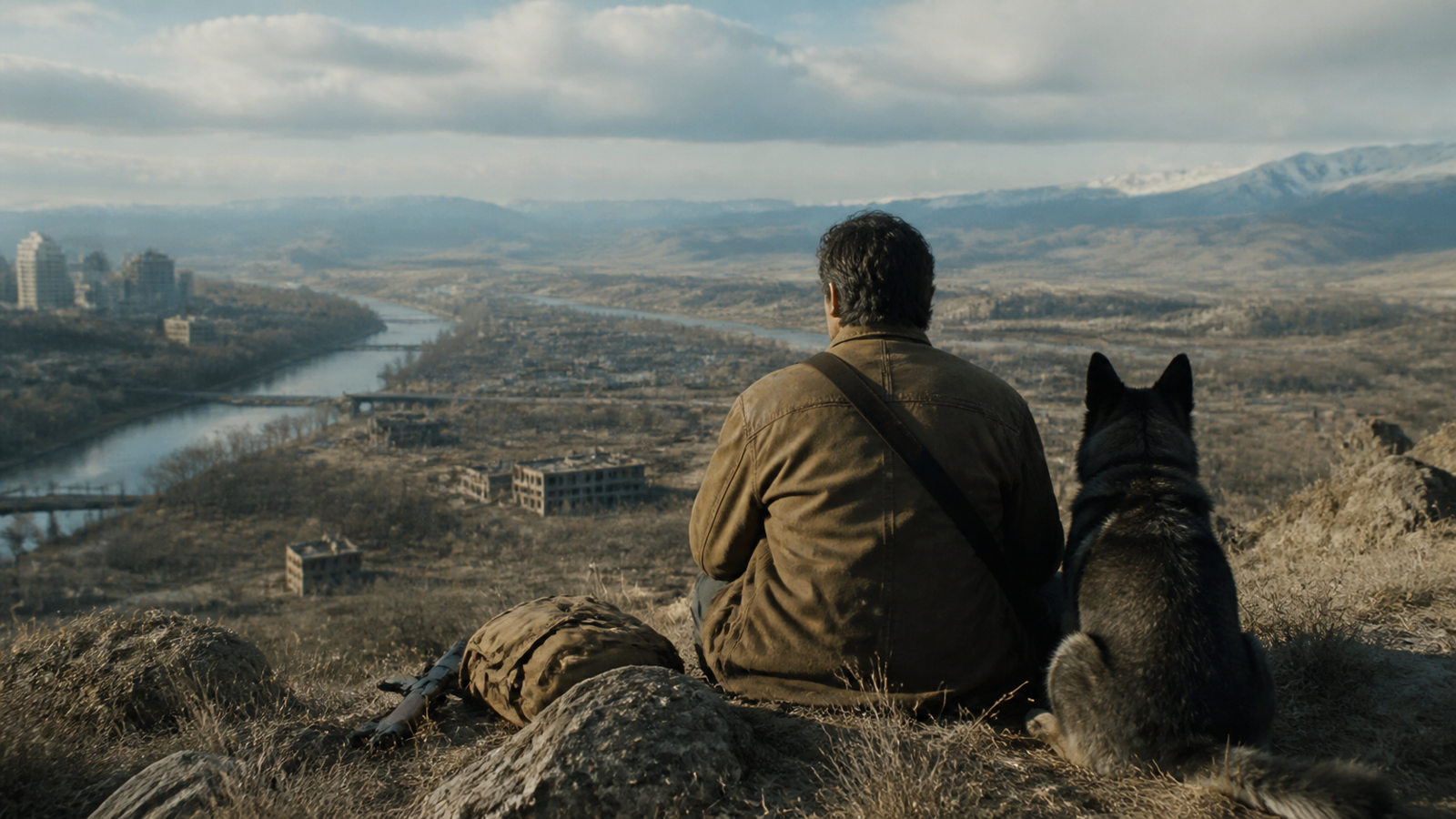
The story is set in 2035 after a deadly flu has devastated the population. Hig, played by Jacob Elordi, is a former mechanic and pilot who still reaches for connection. Brolin’s Bangley is a former Marine who assumes unfamiliar people are threats. Along with Hig’s dog Jasper, they operate from a deserted airstrip in Eerie, Colorado.
The arrangement works because the men provide different forms of security. Hig can fly, repair, and scout. Bangley can defend their perimeter. They do not need to agree about the world to depend on each other, and their friction is part of the system that keeps them alive.
Then Hig hears a voice in a cryptic radio transmission. The signal creates a decision that a movie can show rather than merely discuss: remain inside the safest life available or risk that shelter for the possibility of other people. Peter Heller’s publisher describes the same transmission as the spark for Hig’s hope that a better life might exist beyond the controlled perimeter, confirming that the dilemma comes from the novel rather than being invented for promotion.

This article uses only premise and character material disclosed by the studio, publisher, and released reviews. It does not recount the ending or present itself as an independent review of the whole film.
Scott’s survival economy is about who remains useful
Scott’s interpretation begins with how catastrophe reorders value. In the studio interview, he contrasts people who preserve decency with people who become brutal, then focuses on the skills a damaged society would reward. Farmers and doctors become essential because food and care are immediate needs.
That idea appears in the film through a hidden Mennonite community led by Aaron, played by Benedict Wong. It also explains why Hig’s mechanical and aviation skills matter. A collapsed world does not eliminate expertise; it changes which expertise can be converted directly into food, health, movement, and safety.
The distinction keeps the premise from becoming a simple warning that technology is bad. Hig and Bangley depend on an airplane, radio communications, weapons, stored fuel, and mechanical knowledge. The radio is both a tool and an invitation. The airplane is both a survival asset and the means by which Hig can leave the system that protects him.
Scott’s point is therefore less about rejecting advanced systems than exposing the human work hidden inside them. Modern services can make food, medical care, maintenance, and communication appear automatic. Strip the services away and the people who know how to produce, repair, diagnose, and cooperate become visible again.
That is a thematic reading, not a prediction about how real communities behave after disasters. The source is a director explaining his film, and the claim should stay inside that boundary.
Brolin sees need beneath Bangley’s toughness
Brolin describes Hig and Bangley as mutually dependent even when their exchanges are hostile. Bangley presents himself as someone who needs nothing, yet his role as protector depends on having another person to protect. Hig’s departure therefore threatens more than the airstrip’s division of labor; it removes the relationship that gives Bangley’s vigilance meaning.
That contradiction makes Bangley more than a stock pessimist whose only function is to tell the hopeful hero no. His suspicion may be one reason both men have survived. Hig’s openness, meanwhile, pushes against a life measured only in additional days. The characters embody two necessities that do not fit together cleanly: caution protects life, and connection makes that life recognizably human.
Brolin’s account is evidence about how he approached the role. It is not a command to viewers. Someone can watch the same performance and conclude that the film emphasizes violence, grief, love, or the dog more strongly than unspoken dependence.
A studio’s theme is not the same thing as a critical verdict
The official campaign condenses the film into a contrast between survival as instinct and humanity as choice. That line is effective positioning because it promises an emotional argument beneath the action. Scott’s and Brolin’s comments add detail: humanity means trusting specialized knowledge, accepting mutual need, and deciding that another person’s presence is worth risk.
The film’s release means those intentions can now be compared with independent responses. The Associated Press review, for example, reads the movie as a tender love story within a violent post-pandemic setting. Other viewers may arrive elsewhere. One review does not create a consensus, but its existence matters because the article no longer needs to treat the film as an unseen future release.
The cleanest trust boundary is to separate three questions. The studio and filmmakers can say what they tried to make. A reviewer can say what the finished work communicated to that reviewer. Audiences decide whether the film’s action, performances, and pacing earn the larger claims. Mixing those layers would turn promotional intent into an unsupported verdict.
Why Brolin trusted the adaptation
The Dog Stars adapts Heller’s bestselling novel from a screenplay by Mark L. Smith. Brolin says the book’s poetic quality and social relevance made him cautious about whether a large film could preserve what mattered. He joined after Scott called because he trusted the director’s judgment. Scott, in turn, describes being pulled through the screenplay by how consistently the material held together.
The ensemble also includes Margaret Qualley as Cima, Guy Pearce as Pops, Wong as Aaron, and Allison Janney as Darlene. Principal photography took place in Italy from April through June 2025, according to the Disney interview. Those production facts help explain the scale, but the adaptation problem is not simply how to build a convincing ruined world. Heller’s interior ideas have to become behavior, framing, silence, conflict, and choices an audience can read on screen.
Scott also discusses commercial instinct and the cost of filmmaking. That adds a practical tension to the adaptation: a studio thriller needs movement and spectacle, while a story about loneliness requires stillness and attention. Whether the balance works is exactly where intent stops and criticism begins.
The question left after the apocalypse imagery
Hig risks physical security for the chance that a voice leads to other people. Bangley risks emotional collapse by building his identity around a single bond he cannot easily acknowledge. Farmers and doctors matter because survival is collective. The radio matters because information can also be evidence that the world has not ended everywhere.
That is the filmmakers’ answer to what The Dog Stars is “really about.” The apocalypse is pressure, not the destination. It removes ordinary institutions until trust, usefulness, grief, and the need to be known are impossible to hide.
For more release context, our fall 2026 movie preview places the film in the wider theatrical calendar. Our Netflix September guide covers the month’s at-home arrivals, while what is confirmed about Days of Thunder 2 applies the same line between announced intent and a finished movie.